Viewing entries tagged
petroglyphs

This Week on the Road - February 24-March 4

Comment

This Week on the Road - February 24-March 4

Chilling on my Hill

Beautiful Bryce Canyon

Hello Everyone! It’s been an amazing week out here on the road in southern Utah. I’ve seen some absolutely beautiful country, driven some spectacular roads and visited some amazing archaeological sites. I did have a bit of a stomach bug midweek which wiped me out for a couple of days, but it seems to have passed. The weather has been amazing, the photography opportunities plentiful and it’s just generally been a good week all around.

Wide Angle Look at Bryce Canyon in the Snow

I left off last week in Panguitch, a cute little town about half an hour west of Bryce Canyon National Park. When I finished up last week’s post, I wandered around town for a bit and then made my way on into the park. I’ve been to Bryce at least 50 times in my life and it never ceases to amaze me. The view from one of the many overlooks on a sunny day will rival any view, anywhere in the world for natural splendor and beauty. It truly is nature’s little fairyland. The sandstone spires of Bryce, called “hoodoos”, are mostly the result of the extreme temperature fluctuations Bryce sees during the year. Located above 8000’, it’s not unusual to have freezing temperatures any day of the year, but it can be sunny and warm and beautiful any day as well. It’s the cycle of freezing and thawing which has helped shape the landscape more than wind or flowing water. Bryce Canyon is named after Ebenezer Bryce, who you may remember built the Pine Valley Chapel which I wrote about two weeks ago. He and his wife homesteaded in the area in the 1870s and he spent many months digging a canal to funnel the water to the valley below. When asked about the canyon which would forever bear his name, Bryce was once quoted as saying “it’s a hell of a place to lose a cow”. It most certainly would be. It was quite icy out on the trails this time through, so I settled for a few nice views from the rim. After the sun went down I enjoyed a warm seat by the fire out at Ruby’s Inn, just outside the entrance to the park, where I read my book for a while before calling it a night.

Dusk at Bryce Canyon

Appropriately for the day, I am currently reading a book titled A Hell of a Place to Lose a Cow by Tim Brookes which takes its title from that Bryce quote. It’s a book I’ve read before, but not in some time, about Brookes’ attempt to recreate a hitchhiking trip he had made in 1973 around the U.S. Written in 1998, it is of particular interest to me because the U.S. he is describing in the book is the one I first set off into in the summer of 2000 when I left the east coast and became a cross-country tour guide. Some places, like Bryce Canyon, haven’t changed much in the interim. Some places, like Las Vegas, are completely different. He doesn’t seem to do much hitchhiking though, as he catches a lot of busses and rides along with his photographer. He even rents a car at one point.  I’m about halfway through the book and he has completed his east to west journey from New York to California in just 11 days – not much time to stop and smell the flowers. Both he and his photographer seem bored most of the time and can’t seem to find anywhere of interest (except for Bryce Canyon which they both really enjoy). Of course the America they are seeing is the truck stops and diners located off of the main interstates of the country, not the small towns and state parks off of the beautiful scenic byways I tend to stick with. There are so many books about smashing across the country and not really getting to know it at all. Anyways, it’s an interesting read and an easy one, even if I see more in a week than he did in his entire journey.

Morning in Bryce Canyon

I dipped back into Bryce on Tuesday morning to grab a few snowy photos of the hoodoos, and then headed off along scenic Route 12 across the middle of the state. I stopped briefly in the town of Escalante to learn more about the Hole in the Rock Expedition of 1879-80. In 1879, a group of hearty Mormon pioneers set off to build a wagon road from Escalante to the San Juan River, over some of the most daunting terrain in the state. When they made it to the Colorado River, about halfway to their destination, they found themselves more than 1800’ above the river with no easy way down. They blasted a pathway through the rock, but the descent was at a tremendous 45° angle. The first wagon to attempt the drop through this hole in the rock had blind horses, which didn’t know to protest, and a dozen men behind it trying to control the speed with the wagon’s back wheels locked to prevent a runaway. The whole party made it down safely, and continued on to the San Juan where they built the community of Bluff. The Hole in the Rock expedition is a great story in both American and Mormon history. The historic site in Escalante tells this tale and has some beautiful paintings of the expedition and I really enjoyed learning about it there. My friend was telling me that if you see a tombstone in a Mormon cemetery with a wagon on it, it’s a member of the Hole in the Rock Expedition.

Amazing Fremont Pictograph near Lower Calf Creek Falls

From Escalante, I continued into Grand Staircase Escalante National Monument, a sprawling stretch of Utah which encompasses tremendous scenery all around. It’s not an easy place to photograph, but it is an incredible place to drive through. I made a stop at an overlook next to the highway to see the “100 hands” pictograph panel which is exactly what it sounds like – an old Indian cliff painting of more than a hundred handprints. Who made the panel and what did it mean are both questions lost to history, but it was really cool to see (it was too far away to photograph but I found a similar panel a few days later in Capitol Reef which I got right up close to). Just up the road from this panel, I stopped in to hike to Lower Calf Creek Falls, one of southern Utah’s only real waterfalls. I really loved this hike, the falls at the end, and a wonderful Fremont Indian Pictograph of three characters holding hands along the way. The trail was surprisingly busy for this time of year, but it was a reasonably flat 5 mile round trip and it is one of the most accessible hikes in the park. By “busy” I probably saw a dozen people, but relatively speaking, that was a lot. The hike took more out of me than it should have and I was feeling weak and really tired by the time I got back to my van, so I decided to just grab a campsite there and call it a night.

Beautiful Capitol Reef National Park

I wasn’t feeling great when I woke up, either, but I packed up and pushed on up the road to Anasazi State Park in Boulder. This park has a small Indian ruins site out back and a modern re-creation of what the site might have looked like 800 years ago. It also has some wonderful pottery and baskets inside the museum and interprets the time in which this site was occupied. It was a nice little museum with a great little gift shop and worth a stop. From there, I continued on up the road to Capitol Reef National Park. I stopped and took a few photos on the western approach and then cruised into the main part of the park, where I grabbed a campsite in the old Mormon settlement of Fruita (now an historic site within the park). Fruita is aptly named as there are orchards everywhere in sight and this was once an important agricultural area which supplied fruit and vegetables across state. Still not feeling well, I tucked myself in and called it a night.

The Waterpocket Fold in Capitol Reef

I barely got out of bed on Thursday I was so weak. The only time in my life I have felt so fatigued for no good reason was the first time I had Covid, which is what I was afraid this was. Despite the fatigue, I had no other real symptoms though – no congestion, no respiratory issues, no nothing. I thought maybe I had caught something from the shared tongs and spoons from the salad bar I had eaten at in Bryce, but now I’m pretty sure it was from the food itself. I spent pretty much the whole day in bed, watching movies and feeling sorry for myself. Being sick is never fun, but being sick in 20 square feet of living space is certainly worse. Thankfully the weather was amazing, neither too hot nor too cold but just right for the whole day. I tried to go for a walk in the evening to get some air and some exercise and it seemed to help, but not much.

Capitol Reef’s Hickman Bridge

I was definitely feeling better on Friday, so I packed up and set out to salvage what I could of my visit to Capitol Reef. I drove the scenic road and took two short but amazing walks. The first took me up to Hickman Natural Bridge – a huge rock bridge which you can walk right up and under. The second took me down the Grand Wash, the major canyon which cuts through the middle of the park. It was awesome to walk between the walls which towered a thousand feet above me and the shadows kept it cool and pleasant. I had wanted to see so much more of the park and hike, hike, hike all day, but it was time to move on and I was glad to be feeling better and to have at least seen a bit more than I had in the past.

Goblin Valley at Dusk

From Capitol Reef, I cruised on up Highway 24 all the way to Goblin Valley State Park. This is another park I have been to several times over the years, but always in the middle of the day and in the middle of the summer when it’s really too hot to do very much. I arrived with a little over an hour before the sun went down and really enjoyed walking out among the “goblins” – little sandstone formations that definitely resemble little creatures of the night. The sun was at a good angle to light the goblins up with a lovely, warm glow and it was really nice to be there. After the sun went down, I cruised just outside the park where there are some really great free camping spots on the adjoining BLM land. The sun and the exercise had done me well and I was feeling back up to about 80% by then which was a relief. I had planned on heading out the next morning, but I got an email that night from my old friend Jack who had been the training manager at my tour company for many years. He had literally written the book on hiking in the southwest, or at least the manual which we still use today, and he told me that given the opportunity I should spend a whole day in Goblin Valley, “wandering and wondering” as he put it. I spent some time looking into it and decided to do just that.

Goblins Watching the Sun Set

Not wanting to pay another $20 to get into the park in the morning (Utah state parks are quite pricey), I parked outside the main entrance and walked in for $5. I headed off from there on the Grand Circle Trail out into the desert. I circled the formations which serve as the backdrop to the main amphitheater and made my way to two caves on their back side: the Goblin’s Lair and the Goblette’s Lair. Both were really cool, but I particularly liked the Goblette’s Lair as the entrance made for some amazing photos from inside looking out. From there I headed back around and through the amphitheater of goblins and then on towards the Toadstools. I crossed into the wilderness area where the trails disappeared and came across a sign warning of quicksand ahead. When I was a child I definitely thought I would either die by being sucked into quicksand or by being locked away forever inside some ancient tomb or pyramid, both of which I believed existed not far from Washington D.C. Thankfully, I have managed to survive thus far without falling prey to either and I intended to continue that streak at least through the year. I didn’t get stuck in any quicksand, but the ground was soft out there and strange to walk on, and I definitely felt like I was out on an amazing adventure (albeit within whistling distance of the main road in an emergency). The area where the Toadstools were was really cool and I ended up on top of Curtis Bench which led me back to the road and out of the backcountry. The “adventure” of this hike took place mostly in my imagination, but it was an incredibly fun one nonetheless, and it was really beautiful out there.

Wild Horse Butte in Goblin Valley

In the afternoon, I made my way out of the main section of the park and down the road to the entrance of Wild Horse Canyon, a really cool slot canyon just 10 minutes away. Slot canyons have gotten more and more popular of late thanks to social media, and I was surprised at how many cars were there at the trailhead. As I made my way into the canyon, the walls got closer and closer together and the trail narrowed down to where my boot wouldn’t sit flat on the ground. It was really fun and quite beautiful in there, but it was a little too narrow for me at that time of the day when my patience wasn’t at its peak. I’m not a small man, and my shoulders would have gotten jammed if I had tried to go through facing forward. I probably went about a mile up the canyon and I’m definitely glad I did, but it had been a long day so I found a good place to turn around and slowly made my way out of the canyon. Heading out of the park before dark that evening, I could be a little more selective as to where I camped for the night. I found an absolutely amazing spot up on top of a hill where I parked and pulled up a seat to watch the sunset. The sky was huge up there and the clouds were awesome and the sunset just seemed to go on and on. Later in the night, the stars were great from up there as well and I felt like the luckiest person in the world to have had such a wonderful day in Goblin Valley. Thanks, Jack – you were absolutely right about an extra day.

Wolverton Mill in Hanksville

In the morning, I sat out on “my” hill for a while and read my book and drank coffee as the day warmed up around me. Finally deciding to pack up and head out, I made my way down to nearby Hanksville. I really wanted to check out the Wolverton Mill, which was definitely worth a visit. Built by Edwin Wolverton in 1921 up in the Henry Mountains, the mill was used to try and extract gold from the local rocks. It was never wildly successful, but Wolverton was known to wander into town with some gold dust in his pocket from time to time. After he died, the mill was abandoned and eventually was moved by helicopter to Hanksville, where it sits behind the BLM visitor center. Wolverton’s family helped restore the mill and it is cool to see how it functioned with intact belts and gears. I also enjoyed the old sandstone church in town and some cool historic cabins as well. Right across from the little grocery store was a wonderful outsider art instillation called the Monster Mountain Museum. This outdoor exhibit included a few dozen creatures constructed from found materials in the area and was really well done and worth a stop. By that time, I was getting hungry and the one main restaurant in town had just opened for the season. Duke’s is an interesting little spot dedicated to the memory of John Wayne, the Duke himself. There’s plenty of John Wayne memorabilia around and some great old photos from Hanksville‘s heyday. I had a tasty beef brisket sandwich and seeing as they’re the only restaurant in the country that serves coke but not diet coke, I had a beer to wash it down.

Crossing the Colorado

I enjoyed my meal and then headed on down the highway. Leaving Hanksville I was on Route 95, the Bicentennial Highway (having been finished and dedicated in 1976). This is one of the few major stretches of road in southern Utah which I haven’t driven before and it was a beautiful ride. About 45 minutes from Hanksville, the road crosses the Colorado River and what was once Lake Powel. The lake is all dried up and even the river is looking pretty low these days, but I still got out to take some photos and have a look around. It was hot out there so I continued on down the road until I got to Natural Bridges National Monument. This is another place which has eluded me over the decades and I was definitely looking forward to finally checking it out on this trip. The park is home to three magnificent rock bridges and was designated a National Monument by Teddy Roosevelt in 1908. There is a scenic drive which brings you to overlooks above the canyon, but to be honest the views aren’t very good from above. You really need to get down into the canyon to really appreciate the bridges. I got to the park in time to go and see the first one on the road – Sipapu Bridge. The hike down to Sipapu Bridge is a fun adventure in itself, going town several ladders and across a cool rock ledge past a small Indian ruin. I loved this little hike and the bridge itself was magnificent, especially in the setting sun. I decided to stay the night in the park’s campground which was hard to beat for $16.

Kachina Bridge

I got up the next morning and headed for the second bridge on the loop road – Kachina Bridge. Leaving my van behind, I dropped down once again into the canyon and made my way up and under this massive bridge. After taking some photos, I proceeded down the canyon on the unmaintained trail between the second and third bridges. The beginning and the end of this three mile stretch were beautiful. The middle part, however, was full of little willow trees which whipped up on my bare legs as I walked. It took a while longer to make my way through the canyon than I had anticipated, but when Owachomo Bridge finally came into view, it made it all worthwhile. This long, narrow bridge is absolutely spectacular especially when viewed from below. Ascending back to the canyon rim, I then had to hike up and over the mesa to get back to my van. Thankfully, this trail was significantly easier to follow and was actually quite pleasant. Except at the overlooks, I didn’t see a single person on the trail for the whole 3 hours I was out there.

House on Fire

I was hungry when I got back to my van, so I enjoyed a quick lunch and then jetted out of the park and into adjoining Bear’s Ears National Monument (having seen the namesake “ears” the day before on my drive in and several times in Natural Bridges). I have spent some time in Bear’s Ears before, but was looking forward to seeing a few more little areas on my way through. My first stop was at Mule Canyon, a restored set of ruins just off of the main road. The highlight of this stop is the circular kiva, which would have served as both a community meeting room and ceremonial room when the village was occupied 800+ years ago. Reconstructed to its believed original appearance and covered by a giant canopy, it didn’t really do much for me personally, but I have seen spectacular Ancestral Puebloan ruins across the region for many years. From the ruins, I headed up Mule Canyon to visit the House on Fire which is just about a mile up the trail. House on Fire is just a small set of ruins, but I really enjoyed my visit. These house ruins are fairly complete and the rock formations they were built under make them look like they are ablaze in the right light. I appreciated that it took at least a modest effort to reach them and also that I had the site all to myself. The day was waning by that point, so I headed back to my van and enjoyed my sunset cruise into the small town of Blanding. It may be small, but after the previous week it felt like a thriving metropolis, especially their wonderful little grocery store. I stocked up on a few things and then had a nice little pizza for dinner before tucking in for the night.

Five Kivas Pueblo

Yesterday morning I started my day with a visit to the Five Kivas Pueblo site which is just 5 minutes from downtown Blanding. This set of Ancestral Puebloan ruins flies under the radar, but I absolutely loved them. You can see the ruins from the parking lot across the canyon and it’s maybe a ten minute walk to get to them, but they are wide open to explore and again, I had it all to myself. These aren’t pristine ruins. The graffiti on the walls dates back at least a hundred years and you can tell more than a few beers have been enjoyed by local teenagers in the ruins over the years. That being said, there was no garbage there and the site seemed well maintained. Sometimes it’s good to really get into something and not feel like you’re in a museum. The ruins have held up well over the years and you can definitely see the outlines of the namesake five kivas. There are a few potsherds and even an old corn cob on a ledge and I found the whole place really enjoyable. I’m definitely glad I found them. Leaving the ruins, I spent some time in Blanding’s community rec center, getting a workout in and a much needed shower before spending most of the afternoon in the library trying to catch up. In the evening I went to the only real restaurant in town and had a delicious Navajo taco. These “tacos” are made with Indian fry bread in place of tortillas and are fairly ubiquitous across the country, having their origin in government rationing which often left Indian tribes with flour and little else. The history isn’t joyful, but the fry bread certainly is and I’m always happy to find it when I’m in Indian country.

Inside Bluff Fort

This morning I got an early start and made a beeline for Bluff, about a half hour down the road. I started my visit at Fort Bluff which is a reconstruction of the town that was built by the pioneers who came down the Hole in the Rock trail I described above. There are still some original buildings around town, but the ones in this “fort” were built in the last 15-20 years, mostly through funds and with artifacts provided by the descendants of the original settlers. I really liked the first cabin which was a tribute to the unfortunately named Dick Butt. The main building in the early days was a trading post with a dance hall on the second floor for community dances and events. A thief had tried to blow open the safe in that building using dynamite, but packed in a bit too much and ended up blowing the safe, the building, and himself to smithereens. That’s instant karma if I’ve ever seen it. The reconstruction of that building now serves as the visitor center and gift shop and has an excellent film about the Hole in the Rock Expedition.

The Incredible Wolfman Panel

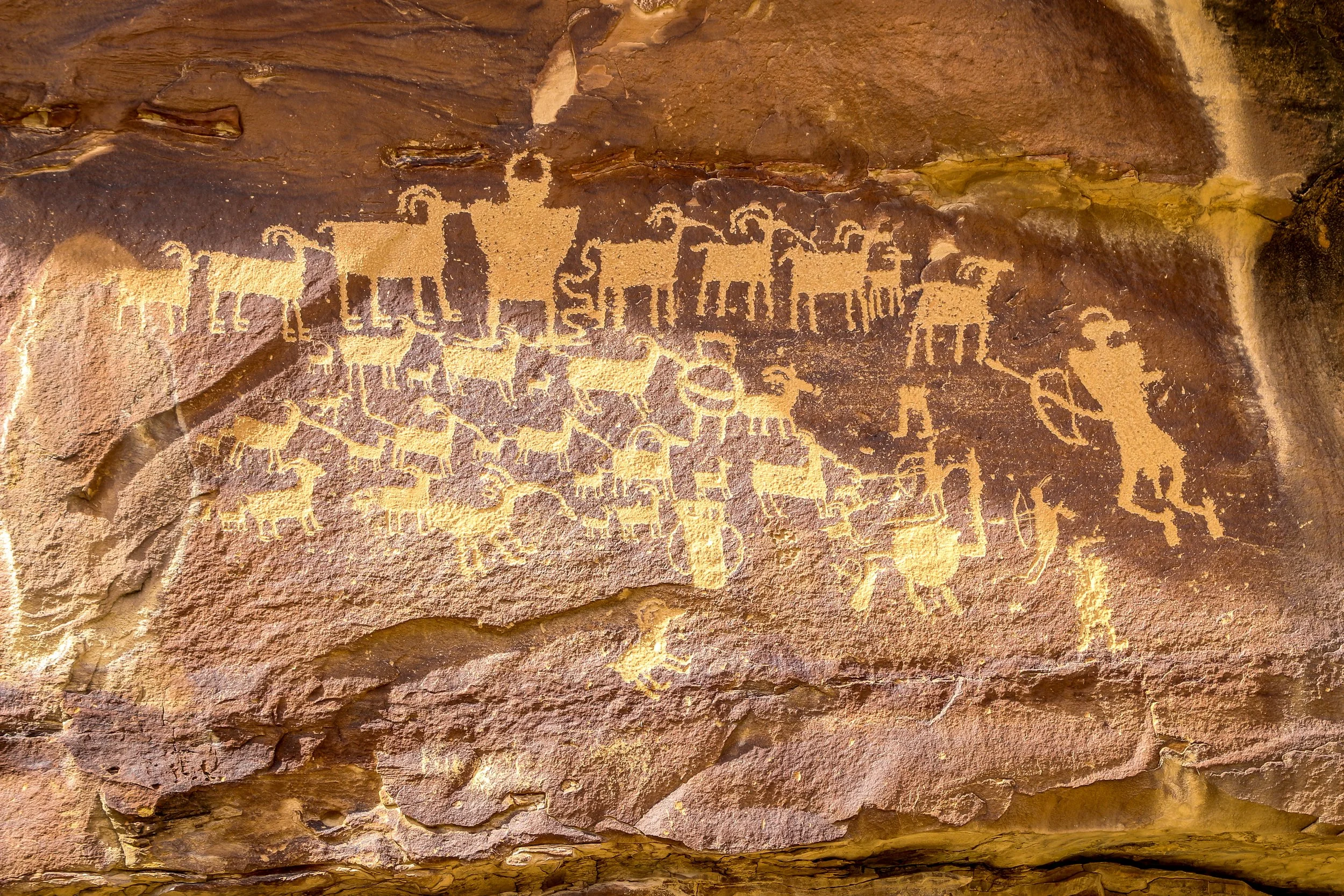
After visiting the fort, I continued south and west and then turned up the Butler Wash on a dirt road and followed it for about a mile. I parked my van and headed out into the Wash and after a bit of hunting found the famous Wolfman Petroglyph Panel. This is one of the most impressive petroglyph panels I’ve seen, even more-so because it dates back to the Basketmaker II Era which ended in 750AD. Compared to most Ancestral Puebloan petroglyphs which are simple geometric shapes or basic animal or humanoid carvings, this one looks like it was done by the Indian Picasso. The lines are clean and clear and it’s very impressive from an artistic perspective even though we have no idea what the carver was trying to portray. It was very cool to see. Just up the wash is another small set of ruins which were definitely worth a visit while I was in the area. From there I made my way back to Blanding, where I will finish up this post here in the local library.

March is upon us and I feel like winter is starting to wind down out here. I know I still have some cold days ahead, but it’s time to start making my way north again. I definitely have some fun plans for the week ahead including visits to Arches and Canyonlands National Parks and maybe even Colorado National Monument across the border into Centennial State (this is another park site which has continually eluded me over the years). I imagine I may be in Colorado at this time next week (although I will be returning to Utah for a couple more weeks immediately thereafter). I hope you’ll check back in with me and see what I get up to. I’m really looking forward to it myself. Thank you, as always, for being a part of this journey.

-Mike

Grand Staircase Escalante Geology

Lower Calf Creek Falls

Moonrise Over Bear’s Ears

Chimney Rock in Capitol Reef

The Torrey Church and Schoolhouse

Country Corner in Escalante

Hands Pictograph in Capitol Reef

The Main Amphitheater in Goblin Valley

Chilling in Goblin Valley

Sunset Goblins

Castle Rock in Goblin Valley

Cool Geology Near Capitol Reef

Sunset Clouds Near Goblin Valley

This One Reminds me of a Pagoda

Inside the Goblette’s Lair

Beautiful Clouds Over Utah

Narrow Wild Horse Slot Canyon

Carl’s Critters at the Monster Mountain Museum

Cool Car at the Mountain Monsters Museum

Owachomo Bridge

Sipapu Bridge

I Loved Goblin Valley

Comment

This Week on the Road - February 12th-18th

Comment

This Week on the Road - February 12th-18th

Hello Everyone!

It’s been an interesting first week here in Utah. I’ve visited some absolutely beautiful places, learned some fascinating history, and generally had a really good time. Utah is a tremendous contrast to Nevada in so many ways. The landscape is on a smaller scale with more canyons and valleys, buttes and mesas and fewer vast stretches of open desert surrounded by imposing mountain ranges. Culturally, Utah is a predominantly Mormon state so it is more modest and conservative than Nevada (in a cultural sense, not necessarily a political one as Utah is also very conservative politically). Mormons are also very serious about preserving their culture and history, especially from the pioneer days which they consider pre-1869 which was when the railroad across Utah was completed. Because of this there is a tremendous amount of information available and the Daughters of Utah Pioneers have some wonderful museums to display items from Utah’s history. Bars are few and far between and with the exception of a few drinks on Mardi Gras Day, I’ve been sober since I arrived in the Beehive State which is a good thing. But also, I haven’t been bored as there are actually things to do at night here which don’t involve alcohol which I’ve really been enjoying. The weather has gone from hot and sunny to blustery and snowy and I haven’t traveled in more than about 60 miles from the border where I entered the state. All in all, it’s been a fascinating week which has really reinvigorated my journey, so let me tell you all about it.

Comment

Snapshots: Three Rivers Petroglyph Site

Comment

Snapshots: Three Rivers Petroglyph Site

The Three Rivers Petroglyph site offers an amazing look into the ancient rock carvings of the Jornada Mogollon people. These rock carvings, created between 900 and 1400 AD, are scattered across a boulder field in the Chihuahuan Desert between the San Andres and Sacramento Mountains. There are over 20,000 recorded petroglyphs in this area, making it one of the most prolific petroglyph sites in the country. While nobody knows the exact meaning of these chiseled carvings, some of the more recognizable animals and birds offer a glimpse into what these ancient people found important. Located 17 miles north of Tularosa and 28 miles south of Carrizozo, this site, managed by the Bureau of Land Management, makes an excellent detour. There is a $5 admission fee to the site, but it is federal land so all National Park passes are also accepted. You could make the one mile out-and-back hike in under an hour, but the longer you stay, the more you will see. I hope you enjoy these photos of a tiny fraction of the carvings at the Three Rivers Petroglyph Site.

Comment

In Focus: Hawai'i Volcanoes National Park

Comment

In Focus: Hawai'i Volcanoes National Park

Hawai’i Volcanoes National Park is a wonderful park full of contrasts on the Big Island of Hawaii. The volcanic landscape seems so harsh and inhospitable and yet beautiful plants and delicate flowers are everywhere within the park. I was very happy to make four visits to this wonderful park during my month in Hawaii and each brought new insights into this amazing park. The Kilauea Iki hike brought us all the way down into this crater to explore the area where just last year a lake of lava could be seen. The Chain of Craters Road took us through incredible volcanic landscapes full of Ohia Lehua trees and lava formations. The Holei Sea Arch at the end of the road was incredible to sit and watch as powerful waves crashed into it and sprayed us on the rocks above. Ancient petroglyphs at Pu’u Loa provided some small insight into what life was like for Native Hawaiians who lived in the area. They buried their children’s umbilical cords here to connect them to the land. While there is currently no flowing lava to see in the park (a huge disappointment for this photographer), it is still a magnificent park with a lot to offer. While I enjoyed many things about Hawaii, this amazing National Park was definitely a highlight. I hope you enjoy these photos from Hawai’i Volcanoes National Park.

Comment