
Hello Everyone!
It’s been an interesting first week here in Utah. I’ve visited some absolutely beautiful places, learned some fascinating history, and generally had a really good time. Utah is a tremendous contrast to Nevada in so many ways. The landscape is on a smaller scale with more canyons and valleys, buttes and mesas and fewer vast stretches of open desert surrounded by imposing mountain ranges. Culturally, Utah is a predominantly Mormon state so it is more modest and conservative than Nevada (in a cultural sense, not necessarily a political one as Utah is also very conservative politically). Mormons are also very serious about preserving their culture and history, especially from the pioneer days which they consider pre-1869 which was when the railroad across Utah was completed. Because of this there is a tremendous amount of information available and the Daughters of Utah Pioneers have some wonderful museums to display items from Utah’s history. Bars are few and far between and with the exception of a few drinks on Mardi Gras Day, I’ve been sober since I arrived in the Beehive State which is a good thing. But also, I haven’t been bored as there are actually things to do at night here which don’t involve alcohol which I’ve really been enjoying. The weather has gone from hot and sunny to blustery and snowy and I haven’t traveled in more than about 60 miles from the border where I entered the state. All in all, it’s been a fascinating week which has really reinvigorated my journey, so let me tell you all about it.
After I finished off this post last week, I headed in and enjoyed the buffet at the casino I was staying at in Mesquite, on the Nevada border with Arizona. I don’t usually eat at buffets and certainly not since they’ve gotten so expensive in places like Vegas, but I figured for $20 I would give it a shot. It was actually pretty good and I’m glad I went. It was “Italian Night”, so they had all kinds of pastas and sauces which I really enjoy and rarely eat so it was definitely a treat. I controlled myself well and left full and content but not overstuffed. It didn’t leave me motivated for a big night out, that’s for sure. I had a couple of beers and played the slots for a while, hitting a couple of nice wins to ensure that I left Mesquite in the black. I actually probably won enough to cover my hotel and food while I was there which was even better. I decided to quit when I was ahead and made it an early night.
I hung around the hotel on Thursday until check-out time, drinking coffee and sitting by the pool. Then I pulled up stakes, waved goodbye to Nevada after a wonderful month and headed on up the highway. You have to cut through a strange little corner of Arizona for 30 miles or so to get to Utah from Mesquite. The road looks like it is heading straight into the hills but as you get closer you see the Virgin River Gorge open up ahead of you and in you glide. The gorge is pretty narrow, and most of the road through there is elevated above the river instead of running alongside of it. It’s quite striking and beautiful and it’s always a warm welcome to Canyon Country.
St. George is just across the border into Utah and is the first real town you come to when arriving into The Beehive State. I’ve passed through St. George a hundred times on my way between Las Vegas and Zion National Park, but I’ve hardly spent any time there at all. I stopped and got gas, which is significantly cheaper in Utah than in Nevada or Arizona, and then hit up the visitor center for some literature. Then I headed downtown to have a stroll and see where the day took me. After checking out some of the old buildings and whimsical statues around Town Square Park, I walked a few blocks north to the old winter home of Brigham Young. If you’re not familiar with Mormon history, Brigham Young took over as the second president of the Church of Jesus Christ of Latter Day Saints after the assassination of church founder Joseph Smith. He was the one who led the Mormons from their one-time home in Nauvoo, Illinois straight across the continent into an untamed stretch of Mexico, only to find when he arrived that this area had been annexed by the United States after the Mexican-American War. Regardless, they settled in and began building their new Zion in the Salt Lake Valley of what they called “Deseret”, which we now call Utah (the state’s oldest newspaper is still called The Deseret News). Once they were established in Salt Lake, Young started sending out small groups of pioneers to establish towns around the region to expand their reach but also with the idea of creating a self-sustaining society. Brigham Young was worried about the impending Civil War, knowing that they were dependent on southern cotton for their conservative clothing in a hot desert environment where wool simply wouldn’t do. St. George was founded with the idea of growing cotton and he sent several people familiar with cotton to help. The area soon took the nickname “Dixie” which it is still often referred to as today as the big “D” on the mesa on the edge of town attests to. Anyways, Brigham Young had rheumatism, so he spent his winters in the warmer climates of St. George, returning to Salt Lake in the spring. He built a house which is now owned by the church and which is open for tours. I had a wonderful tour of the house and learned a lot about the city and the area. My guide didn’t mince words and talked openly about Young’s several wives. He showed me some wine decanters and reminded me that alcohol wasn’t forbidden among Mormons until much later and winemaking was actually a big industry in early St. George as they had an eager market in nearby Nevada mining communities. Mostly Utah pioneers drank wine for the same reason most western emigrants did – they didn’t trust the water (actually hard cider was the most prevalent drink on the frontier right up until prohibition). I also found the lack of forks in the house interesting as forks were apparently associated with the devil. We had a good time chatting as we worked our way through the house and I really enjoyed my tour and my conversation.
From there, I wandered down the road to the St. George Tabernacle, which early settlers had begun construction of almost immediately to have a central location to meet in their new town. It’s a beautiful building and still holds that function today. My guide there told me an interesting story from the early days in which a Catholic priest had requested to use the tabernacle to hold mass for miners in one of the local boomtowns. Not only did they allow it, but the local Mormons learned some hymns in Latin so they could help him out. I found some of the Masonic symbolism in the building quite interesting as well as I hadn’t considered that Mormons would be freemasons, but apparently many were. I had such a great afternoon just strolling around and visiting these historic buildings and learning more about the local church and its history. I appreciated the openness of the docents I interacted with and really felt like I could ask them anything and they would answer to the best of their knowledge. By the time I left the tabernacle, it was getting late and I was getting hungry so I stopped off at Icicles, a local burger joint, to try a Utah specialty – the pastrami burger. This is basically just a regular burger topped with sliced pastrami, but it actually really affects the taste and in a good way. I paired my burger with the thickest, most beautiful hand cut and breaded onion rings I’ve ever seen and, of course, plenty of “fry sauce” (a real Utah specialty).
After dinner, I went for a nice evening stroll down to the beautiful St. George Temple which really is quite stunning. I enjoyed wandering around the grounds and taking photos and picturing in my head this grand structure rising from the desert in the early days of the town. After the sun went down, I left the Temple grounds and wandered over to The Electric Theatre. Built in 1911, The Electric was the first movie theatre in southern Utah and the first air-conditioned building in St. George. It now hosts all kinds of local events and I was there to see a production of a play called Next to Normal. As I alluded to in my intro this week, one of the things I am looking forward to the most about Utah is the plethora of evening offerings which have nothing to do with alcohol and this was a perfect start. The production, though minimalist, was very well done. It was a story about a suburban American family who is struggling with mental health, addiction and dysfunction. The director, who is from Washington D.C., commented that they agreed to do the play because of how low Utah ranks as far as mental health goes in the country (which surprised me as much as it didn’t if that makes sense). It was pretty gritty and brutally honest from jump and I left at the end a little bit jarred and with a lot to think about, which I think is a really good way to leave a movie or a play sometimes. Anyways, I thought it was really good and I’m glad I chose that one from the three (or more) plays which were on in tiny St. George on a Thursday night in February.
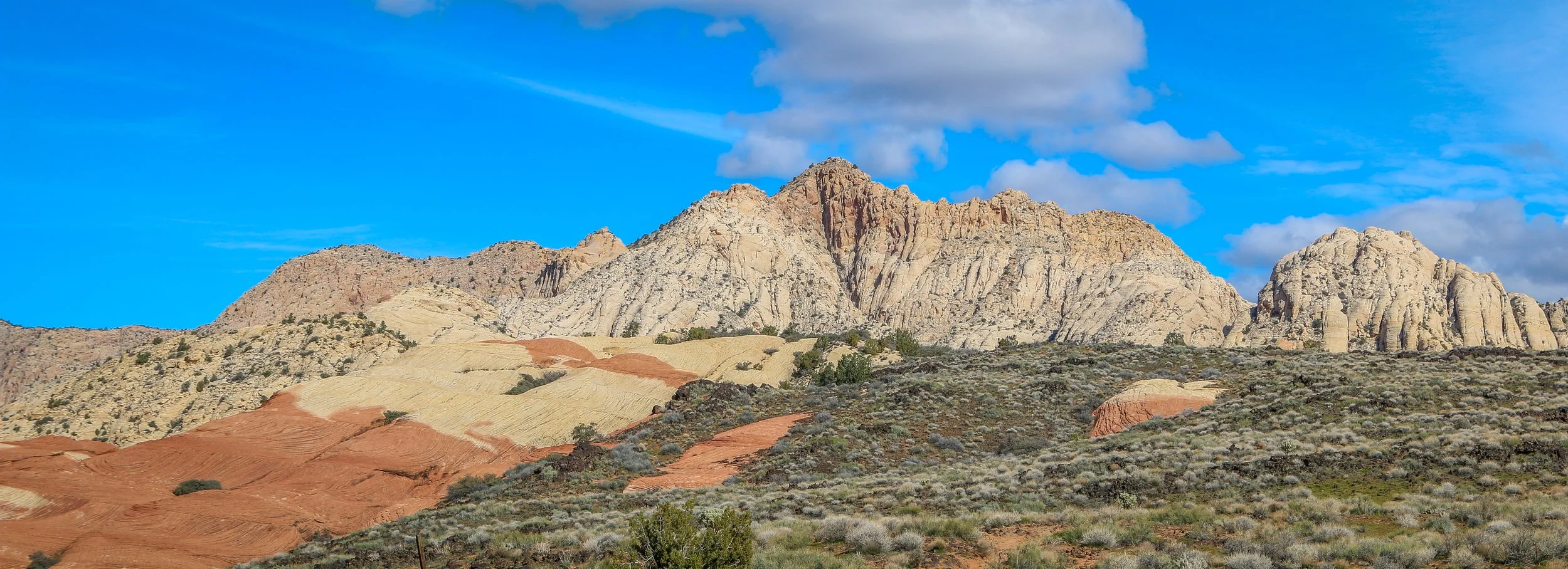
I had a big box of m&ms at the theatre, which I definitely shouldn’t have done, so I didn’t sleep great that night. I’m also dealing with some sort of allergy here in the high desert which didn’t help. I shouldn’t complain though, as I apparently sleep better than most adults do. Regardless, I was up early and shot about 20 minutes up the road to Snow Canyon State Park. Originally called Dixie State Park, it was later renamed for Lorenzo and Erastus Snow, two local Mormon pioneers. This was one of the most beautiful state parks I’ve ever seen and I was so glad to have the whole day there. It looked a lot like Zion National Park (which isn’t far away at all, so that makes sense), but it was also completely different. I’ve spent a lot of my life in Zion, so this was like visiting an old friend in a new house with a fresh hairstyle. The scenery and geology was very familiar, but all of the trails were new to me and spectacular. I started the day in the main part of the canyon, scaling the old petrified dunes and then dropping into the valley. From there I wandered up the canyon, craning my neck to look up at the beautiful sandstone cliffs. Then I curved around to check out some of the volcanic landscape and lava tubes which you won’t find in Zion.
After my morning hike, I stopped by my van to have some lunch and then drove down to the south of the park where I hiked up to beautiful Scout Cave. While I didn’t love the fact that this trail followed the property line of the park and was right next to the adjoining neighborhood, the view from the cave when I got there made it all worthwhile. I also hiked up Johnson Canyon while I was in the south of the park which was beautiful and shaded and so much cooler than it was in the sun. There was some water in the canyon and I was treated to the song of a thousand frogs as I hiked. I was out there for most of the afternoon and then headed back to St. George to have dinner with a friend of mine from my tour guiding days. Shirley was actually a guide with my company before my time and I met her at a recent reunion, but it was nice to spend some time with her and her husband, John. They’ve had a rough year of loss as well, so we consoled each other on those challenges and talked about the travels we are looking forward to in the years ahead. The time really flew by, but I really enjoyed their company.
I spent Saturday morning taking a nice long walk up the Virgin River from where I had parked for the night. It was a beautiful morning and I just started walking and ended up probably doing about 5 miles out there. The trails around St. George are beautifully maintained, well signed and easy to follow. When I finished there I popped by the bookstore to pick up a Utah guidebook and then headed to the local Rec Center to get a workout in. Then I got some much needed work done in the town’s wonderful library. At 7pm I made my way back to the St. George Tabernacle for an evening of music with local singer Christian Erickson. Christian is only 21 years old, but he was there to sing some old crooner love songs from Frank Sinatra and Dean Martin etc. The crowd loved him and I enjoyed it as well. The acoustics were good and it is a beautiful historic building to be in. My guide from my visit on Thursday recognized me and I thanked him for his Snow Canyon recommendations and we chatted a bit before the show. Afterwards I went up the road to Nielsen’s Frozen Custard for a little Valentine’s Day treat to myself before calling it a night.
I slept in a bit on Sunday and took care of some errands and logistics in the morning so I could have the rest of the day free. Leaving St. George, I headed up Route 18 and then ducked off to head up into the mountains and to the town of Pine Valley. When the Mormons were settling Southern Utah there weren’t a lot of trees around, so much of the construction material had to find its way down from Pine Valley. It’s a cute little town with some nice old buildings and some massive new homes as well, but I was there to see the old chapel. The Pine Valley Chapel was built in 1868 under the supervision of Ebenezer Bryce, after whom Bryce Canyon National Park was named. Born in Scotland and later converted to Mormonism, Bryce was a shipbuilder by trade. This apparently made him the most qualified man in town to take charge of this project. He used what he knew and built the chapel like an upside down ship. When it was completed he said “if a flood should come, it would float, and if a wind came strong enough to blow it over, it would never crash to pieces”. It’s a beautiful old chapel and I’m glad I stopped to see it.
Back on the highway and just north of the turnoff to Pine Valley is the site of the 1857 Mountain Meadows Massacre – one of the most violent and jarring events in Utah history and a place I’ve been reading about for years and had to see while I was in the area. After years of persecution by the United States, the local Mormon militia decided to take their revenge on an unknowing and uninvolved emigrant party from Arkansas on their way to California. The initial attack on the emigrants killed 10 people but the siege lasted for five days. Finally the Mormon militia approached the encampment under a white flag and convinced the emigrants that they were there to escort them through the valley. Soon thereafter they slaughtered every man, woman and child over the age of 6, stripped them of all of their belongings including their clothes and left them to rot in the desert. The U.S. Army eventually came to the meadow and buried the bodies in a mass grave. Only one of the attackers was ever truly brought to justice, facing a firing squad not far from where the attack had taken place. There is a newish memorial there now and it fairly interprets the events that took place that day. You can read the official statement from the Mormon Church on one of the signs which assumes full culpability for the attack, including their enlistment of local Paiute Indians to assist them and their attempt to place blame on the Indians in the aftermath. The Mountain Meadows Memorial is a truly heart-wrenching place to visit, but also memorializes an important chapter in Utah and U.S. history. Nowhere does the Mormon Church try and explain any of the background or reasons behind the attack (which were many), because cold-blooded murder is never excusable and it very much contradicts the most closely held beliefs of the church. I was actually surprised that I wasn’t there alone and that several groups stopped to visit the memorial during the hour or so I was there.
The day was waning at that point, and I had one more stop on my agenda. About 40 minutes up the road is the old Iron Town, which was exactly what it sounds like – an old iron producing site. Much like St. George was established to produce cotton, Iron Town was established to produce iron which had limited success despite the best efforts of those in charge. There isn’t much to it these days, just some old ruins and a beautifully preserved charcoal kiln, but it was a nice place to wander through as the daylight faded. After a completely overcast day, the sun broke through at the last minute, lighting up the sky in a beautiful display and I used the last of the daylight to make my way into Cedar City. I really just cruised through town and pulled into my night stop, cooked up some dinner and then called it a night. It was a busy day in southwest Utah, but a really interesting one.
I spent the morning on Monday at Starbucks, trying to catch up on some photos and then made my way over to Frontier Homestead State Park. It was really windy out which is apparently pretty common in Cedar City, but it was most unpleasant to be out in. This small state park, which is really a museum, had some really interesting displays. The first and most interesting to me was about the old Utah Parks Company which was an early tour concessionaire associated with the Union Pacific Railroad which brought tourists from Cedar City out to Bryce Canyon, Zion, Cedar Breaks and Grand Canyon. The exhibit focused on the experience of the tourists at the time, but also on the people who worked for the company. It certainly was a different time and a different experience but I’m sure everyone enjoyed the parks as much then as they do today. Outside were some great old pioneer buildings from early Cedar City, and the one I found most interesting was the schoolhouse. It seemed that most early settlers, from the burliest silver miners to the most saintly of Mormons, really wanted their children to be educated which was why you’d always find a school in any western town. What I found interesting about this schoolhouse was it had information on the “Deseret Alphabet”, which was entirely new to me. It seems that this was a time when new Mormon converts were making their way to Utah from all over the world and learning English was obviously of utmost importance. Brigham Young devised a phonetic alphabet which he hoped would speed up this learning by taking the guesswork out of the different ways a letter could be pronounced. As a former teacher of English as a foreign language, I completely understand how difficult English can be to learn and I found this system fascinating. It never really took off though and despite being taught for about 20 years in Utah it would fade away after Brigham Young died in 1877.
Cedar City was expecting more wind and ice and snow that night, so I thought it would be best to head out towards where I was planning on staying and stick close to that for the night. There was a little Asian fusion restaurant right there which had interesting combination plates from different cultures (the one I chose had Singapore style noodles, Thai Curry and Chinese soup). After dinner I went just up the road to the movie theatre. There wasn’t anything showing which I was super interested in, so I settled for the new Pirates of the Caribbean movie which was full of swashbuckling silliness but was also entertaining and enjoyable and worth the special $5 ticket price on a Monday night.
We did get wind and ice and snow that night, but it wasn’t too bad. The streets were pretty dry when I woke up and only the side of my van faced into the wind needed to be cleared. While I had planned on sticking around Cedar City for another day or two, they were calling for real snow last night so I decided to take advantage of the sunny day and hit as much as I could before dark. I started my day out at the Parowan Gap, a fascinating old river canyon seemingly in the middle of nowhere about a half hour northwest of Cedar City. The reason I was there was because Parowan Gap has one of the most concentrated collections of petroglyphs (Indian rock carvings) in the country. This area was home to the Fremont Indians from around 500 AD to around 1300 AD and they left over 1500 carvings on the walls of the gap. The Paiute and Hopi consider the Fremont people to be their ancestors and consider the Parowan Gap to be sacred and they have helped to interpret some of the carvings. While I’ve seen plenty of petroglyphs in my life, this was an interesting collection and worth the detour.
From there I headed to downtown Parowan, Southern Utah’s first Mormon settlement. Settled January 13th, 1851 in the midst of a blizzard, Parowan is now the county seat of Iron County. The Parowan Rock Church was completed in 1867, making it the oldest church in southern Utah. It is no longer used as a church, but has served many purposes over the years and currently houses a local museum. There are some cool old buildings and houses around town as well as some descriptive historical plaques recounting Parowan’s early history. I had a great chat with the lady at the visitor center who grew up in Salt Lake and only after moving to Parowan realized that she had family ties there and that her fourth-great-grandparents were buried in the Parowan Cemetery. The cemetery is quite interesting and includes at least one of the “Pioneers of 1847” who made their way across the country with Brigham Young. Buried nearby is Almera Johnson Smith Barton who had been married to the Prophet Joseph Smith (one of at least 30 wives Smith had in his lifetime). There were many other interesting headstones to look at in the Parowan Cemetery, but those really stuck out.
I left Parowan and circled back to Cedar City. I wanted to get some photos of the Temple there and a few other shots downtown before I took off. I stopped into the little museum of the Daughters of Utah Pioneers and had a lovely chat with the ladies there about all sort of different topics. They were quite knowledgeable and shared some interesting stories with me including the fact that one of only two photos of the old Nauvoo Temple in Illinois known to exist was found in Cedar City (the Temple was destroyed in the 1850s but someone had taken a photo before the Mormons left in 1847). While the actual photo is in Salt Lake City for safekeeping, they had a cool copy on display. When I left the museum, I stopped into The Soda Nerd for another distinctly Utah experience – the dirty soda. Mormon doctrine prohibits its followers from using alcohol, tobacco or “hot drinks” which the church has clarified means coffee and tea, not necessarily caffeinated beverages (although many Mormons choose to abstain from these as caffeine is addictive). This has led to a strange soda culture in the state where they mix different sodas, syrups, flavorings and creams into distinct non-alcoholic cocktails. I’m not big on soda, but I had to try one while I was here and found it quite interesting.
I took off from Cedar City and headed straight for the Kolob Canyon section of Zion National Park. While I’ve spent plenty of time in Zion, I’ve only been to this section of the park once or twice and never been able to hike there. While the day was waning and the clouds were threatening, I thought I could get in a two hour hike before the sun went down. I started up the Taylor Creek trail which heads straight for the heart of the canyon. I only ran into one couple out there, so had the trail basically all to myself. I didn’t quite get to the end of the trail as I had a hard turnaround time to be sure I got out before dark, but I really enjoyed the hike and the exercise. It was only a half hour back to St. George from there but the headwind was strong on the road and it was a more challenging drive than I would have liked. I got back right as the daylight disappeared from the edges of the sky. Yesterday was Mardi Gras, one of my favorite days, but one which doesn’t make a lot of headlines in Utah. I went to a local spot called Rusty Crab Daddy’s for dinner and was able to get a bowl of gumbo and 3 pounds of boiled crawfish. The gumbo was good and the crawfish were okay – obviously frozen but not horrible – but I was thrilled they were there nonetheless. Seeing as it was Mardi Gras I decided to step off the wagon for the night and went to a local speakeasy called Spiritual to have a cocktail. As it turned out, they had a lot of New Orleans favorites, so I enjoyed a Sazerac and some cool jazz music. The place got busy so I didn’t stay too late, but I really enjoyed it and my Mardi Gras turned into a pretty decent night after a very busy day.
Cedar City got some serious snow last night so I’m glad I bailed. It was snowing here in St. George when I got up this morning, but not too bad and it didn’t stick. I headed to the gym for a while and the snow cleared out. It’s still windy out, but it’s been sunny all afternoon which is good. I’m tucked in here at the St. George library trying to finish up this post. I know it’s longer than usual, but I saw a lot of interesting things this week which needed (for me at least) some extra explanation. I’m probably going to go to the Opera House tonight for anther show if I can get my work done in time. If the weather is decent, I plan on leaving St. George tomorrow and heading east. I’ve got some small towns to visit and some hikes I want to do this week and I hope to catch some of the Hot Air Balloon Festival in Kanab this weekend. I have no idea where I’ll be at this time next week, and I’m actually not 100% sure I’ll find somewhere to get this newsletter out as I’m heading to the sparse center of southern Utah from here but I’ll surely try. Have a wonderful week out there, wherever you are, and thank you, as always, for reading.
-Mike