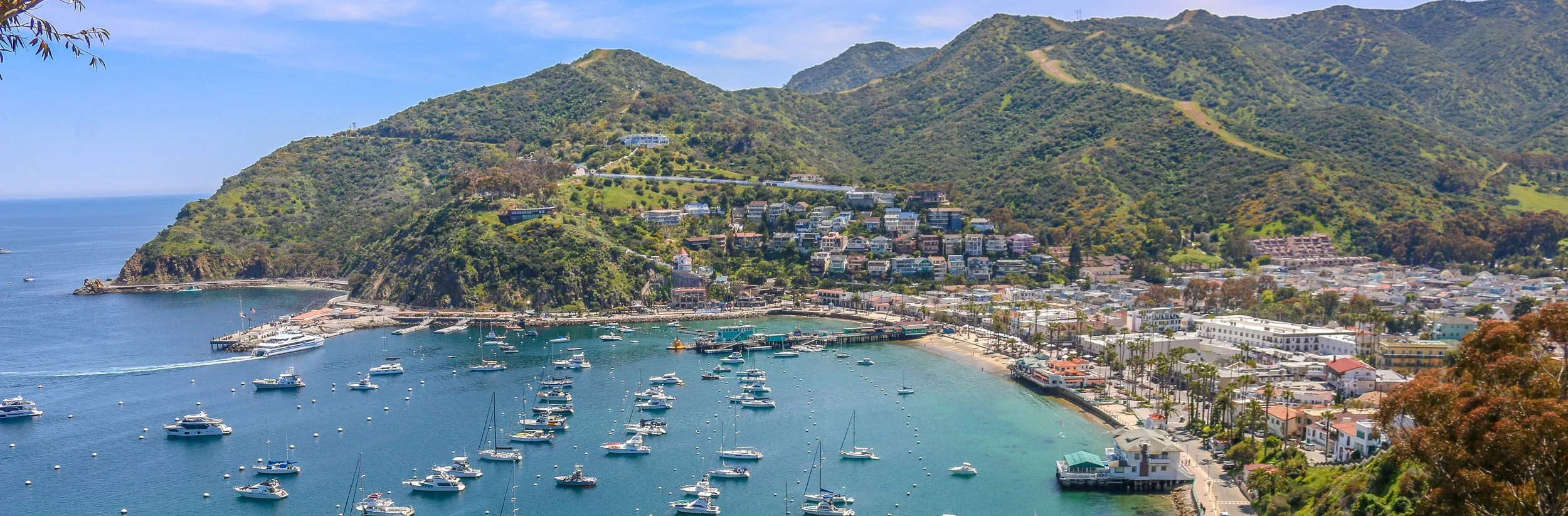
Avalon! Just hearing the name of this magical place will always make me smile. Avalon is the only town in California’s beautiful Channel Islands and is located on the easternmost island of Santa Catalina, just a short hour’s ferry ride from the mainland. It may be only an hour away, but it is a world apart and landing at the port feels like you’ve arrived in a far off land.
Catalina Island was once home to the Tongva people who used the island’s abundant soapstone to trade with other bands on the mainland and the other islands. It was purchased in its entirety by James Shatto in 1887 and Shatto built the island’s first pier and hotel hoping to attract tourists from Los Angeles. He had a tough time of it though and sold the island to the Banning Brothers just four years later. They had some level of success in developing the island’s tourism potential, but a devastating fire in 1915 and the general decline in tourism due to World War I caused them to look for a buyer themselves.
The man they found was William Wrigley Jr. of Wrigley Chewing Gum fame who purchased the island from the Bannings in 1919. Wrigley had the capital and the drive to make Avalon and Catalina Island a success. Wrigley built the Casino which is a theater, ballroom and gathering place and has never been a gambling hall. He purchased steamships to bring people to the island and built hotels to house them and restaurants to feed them. Wrigley owned the Chicago Cubs and had the team hold their spring training on Catalina from 1921-1951. Tourists came in droves, including many Hollywood stars.
After William Wrigley’s death in 1932, his son Philip took over and continued to promote Avalon and Catalina Island. During World War II, the island served as a training facility for the military, but after the war tourism would continue to grow. Philip was sensible enough to think of the long-term health of the island and signed over 88% of the island’s land to the Catalina Island Conservancy in 1975 to be kept in its natural state in perpetuity.
I had a great time in Avalon. I enjoyed some beach time at Descano Beach under the palm trees where I also tried the island’s signature cocktail: Buffalo Milk. I toured the Casino and saw the world’s largest circular uninterrupted dance floor. Our guide told us stories about the heard of bison which was brought to the island for the filming of Zane Grey’s The Vanishing American in the 1920s. They were left on the island and now roam free in a herd of over 150. We learned how Norma Jean Dougherty moved to the island when she was 16 and married a naval enlisted man. She worked pulling taffy at Lloyd’s Candy Shop (which is still there) and her husband was a projectionist at the Casino. Years later the world would meet her as Marilyn Monroe, but the island still remembers her as Norma Jean. An exotic bird park on the island was used to record the sounds used for the flying monkeys in the Wizard of Oz. The stories went on and on, one more interesting than the next. I learned more island stories at Avalon’s wonderful history museum and enjoyed a wonderful fresh fish dinner at the Lobster Trap and delicious strawberry pancakes at the Pancake Cottage the next morning. I climbed up the hill to the beautiful Chime Tower which chimes the quarter hour and provides amazing views over the town. I was only there for a day and a half, but I felt like it was much longer. I will always remember my time on beautiful Catalina Island and will definitely return in the future. I hope you enjoy these photos from Avalon, the jewel of Catalina Island.
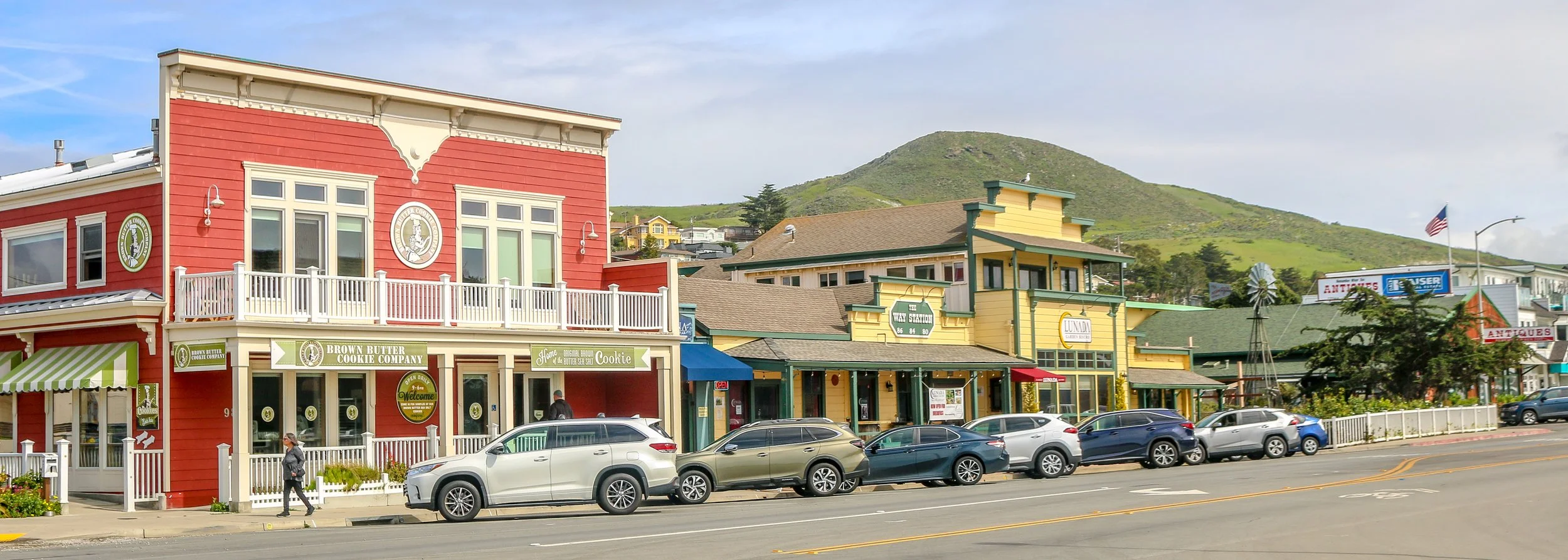
Cayucos is a pleasant beach community located on the Estero Bay along the Central California Coast. Originally inhabited by the Chumash people, the area was explored by the Portola Expedition in 1769. The Spanish explorers noted the Chumash out fishing in small canoes and named the area Cayucos - the Spanish name for a small boat. The town was established in 1867 by Captain James Cass who built the original pier and a warehouse to store goods and make Cayucos a port town. Today Cayucos is home to around 2500 people and is a great town to stop in on your journey up or down the coast.
I stumbled into Cayucos by accident as I made my way down the Pacific Coast Highway. I stopped near the pier to use the bathroom and was impressed by the Dale Evers’ statue called The Great Communicators at the head of the pier (pictured below). I decided to stroll down the pier and enjoyed watching the surfers catch some waves. As I walked back towards my van, I saw a cool old convertible make the turn in front of me and looked down the street to see the Brown Butter Baking Company. Of course I had to stop for a cookie for research purposes, and I started to see all kinds of cool buildings to photograph. I ended up staying in Cayucos for a few hours and really enjoyed the town. It had all the amenities of any beach town along the coast, but was wonderfully clean, quiet and friendly. It’s a town I will definitely be back to and I see where they get their nickname: A Little Slice of Paradise. I hope you enjoy these photos from beautiful Cayucos, California.
Most of the states I’ve been to seem to have a town like Solvang - a place with solid European roots that has developed into a tourism draw over the years. Some of my favorites have been Helen, Georgia, Frankenmuth, Michigan, New Ulm, Minnesota and Helvetia, West Virginia. All of these have had either a German or Swiss background, which made the Danish village of Solvang different and quite fun for me to explore.
The area where Solvang now stands was originally Chumash land. In 1804, the Spanish built Mission Santa Inés, one of 21 Catholic missions they would establish in Alta California to try and convert the native peoples and help the Spanish claim to the territory. After Mexico won its independence in 1821, the mission system was dissolved and the land was divided into land grants and this area became part of Rancho San Carlos de Jonata.
Beginning in 1850, many Danish immigrants began arriving on America’s shores including some of my ancestors on my father’s side. Communities would begin to form, especially in the Midwest. In 1910, a small group of Danish men decided to try somewhere a little warmer and purchased land in the Santa Inés Valley. A year later, a town plan had been drawn up and Solvang was born.
Originally, the town looked like many others in the region but after World War II many buildings were built or rebuilt in a more Scandinavian style. Today, Solvang is definitely an eye-catching place, especially the windmills which are scattered around the town. Tourism is a major draw with people coming from all over the world to visit the delicious bakeries and restaurants.
I had a great time in Solvang. It was busy but not crazy and I couldn’t help but smile as I wandered around taking these photos. It felt familiar yet different at the same time and it is definitely worth a visit if you’re looking for a break from the coastal beach towns and Mission architecture. I hope you enjoy these photos from beautiful Solvang, California’s Danish capital.
If there’s a more classically Californian beach town than Pismo Beach, I have yet to find it. Just driving into town makes your stress start to fade away and when you find a parking spot you can take a deep breath and relax - you have arrived. Pismo Beach residents have made an obvious effort to create and maintain this laid-back, surfer vibe and they’ve built a beautiful town around it. The fact that I was there on a beautiful sunny day didn’t hurt.
This area is historically home to the Chumash people, and “Pismu” was their name for the tar they found in the area which they used to seal their canoes and baskets. The Spanish Portolá Expedition passed by the beach in 1769 and after Mexican independence it would be included in José Ortega’s Rancho Pismo. A town was established in 1891 and the first pier was built in 1924. Pismo Beach was long called the “Clam Capital of the World” and these delicious mollusks drew people from miles around, but overharvesting has devastated the local clam population. Today the town states simply that they are “Classic California” and they definitely live up to that claim. While there is a lot more to California than surfing and beaches, that is the image that many people have of the Golden State. If that’s what you are looking for, you won’t find a better place to experience it than beautiful Pismo Beach. I hope you enjoy these photos from this classic California surf town.
Bodega, California is an adorable historic town about 5 miles from the coast and 2 hours north of San Francisco on the Pacific Coast Highway. These were once Coastal Miwok lands and they made use of the bounty of the area’s vast natural resources. Juan Francisco Bodega y Caudra of Spain first sailed into the nearby harbor in 1775, but the area’s first settlers of European decent were Russians. It was fear of the Russians’ southern advances that prompted Spain to set up the mission system and claim and settle the area of what’s now California.
In 1843, Stephen Smith built a lumber yard in the area and John Sutter also bought land nearby. St. Teresa of Avila church was constructed in 1859 and a small community slowly grew up around it. Today, Bodega’s population is still just over 200 people, but it packs a lot of punch for such a small town. Bodega is probably best known as one of the filming locations for Alfred Hitchcock’s 1963 film The Birds. I used to drive through Bodega often on my way from Santa Rosa to the coast, and I was happy that I finally had the chance to stop and look around for a while. Bodega is definitely small-town California at its best. I hope you enjoy these photos from beautiful Bodega, California.
Hello Everyone!
It’s been another week of wet weather here in California. Thankfully it hasn’t been steady rain, but more on and off and I’ve been able to get out and see some things and even take a few photos. I enjoyed a fun St. Patrick’s Day in Santa Barbara and caught up with an old friend yesterday here in Oxnard. I have definitely moved strongly into Southern California this week and I’ve been having a great time. I had forgotten how much I enjoy the laid-back vibes and relaxed atmosphere of SoCal. I’m also looking forward to heading out to the island of Santa Cruz in Channel Islands National Park tomorrow if the weather allows me, so I’m going to get this post out a day early this week.
I wrote this post last week from the small but mighty town of Pismo Beach. Once I was finished putting it together, I headed out to check out the town and really fell in love with it. Pismo Beach is a quintessential California beach town full of neon and surfboards. If you grew up listening to the Beach Boys and are looking for that kind of vibe, Pismo definitely has it. I really enjoyed just wandering around and taking photos and soaking up some much needed rays. I stayed in town long enough to watch the sun set and then headed just down the road to Santa Maria.
I was very excited to have a taste of Santa Maria-style barbecue, but was also somewhat reserved in my expectations. I’ve experienced so many culinary treats around the country that I’ve learned to enjoy them in their place and then hold them in my memory until I return. Barbecue is most definitely a southern thing, and I don’t usually go for it west of Texas or north of the Mason-Dixon Line. However, since Santa Maria claims their own unique style I had to try it. I chose Shaw’s, because they’ve been around for a long time and because they had tri-tip on their menu and tri-tip (sometimes called a “California cut”) is also unique to Southern California. Tri-tip is also called “poor man’s brisket”, so I thought it would be great to try it smoked low and slow. What I didn’t look at closely enough is that Santa Maria Style is a way of barbecuing, the verb, not barbecue, the noun. It’s simply their way of seasoning and grilling meat and has nothing to do with the slow-smoked deliciousness of our southeastern region. Because of that, tri-tip was not a good choice because, while flavorful, it’s also super tough. I should’ve gone with a ribeye or a strip. My steak had good flavor and I could taste where it was going, but I didn’t enjoy it as much as I had hoped I would. It did come with a delicious soup, amazing homemade salsa, a relish tray, garlic bread and baked beans making for quite a feast, but my tri-tip was a disappointment. I will return to Santa Maria again with a different idea of what to look for though as I think it definitely has potential. The people of Santa Maria were kind and welcoming though and that would be reason enough to return.
On Thursday I continued south to La Purisma Mission, another of the 21 historic Spanish missions in California. This one had fallen into serious disrepair when it was taken over by California State Parks and was reconstructed by the Civilian Conservation Corps in the 1930s. The CCC rebuilt it to capture the historic context of the mission during its heyday so it is a fascinating place to visit and get a feel for what the missions were really like…
The area that is now Wickenburg was once Yavapai Indian land and the river that runs through it is the Hassayampa which means “following the water as far as it goes” in the Yavapai language. In 1863, German prospector Henry Wickenburg came to the area in search of gold. He found it and opened the Vulture Mine which would eventually produce 340,000 ounces of gold and 260,000 ounces of silver.
Ranchers came to the area as well and soon a community sprang up. In 1895, the railroad came through Wickenburg which spawned even more growth. The town was incorporated in 1909, making Wickenburg the oldest Arizona town north of Tucson and the 5th oldest in the state. In 1866, Wickenburg missed being named the territorial capital by just two votes.
Today Wickenburg is a quaint little community with a real wild west feel to it (some of the light posts are even wearing cowboy hats). There are some amazing art installations around town and the Desert Caballeros Western Museum is one of the best in the state. I love the design of the Saguaro Theatre which was also probably my favorite theatre in Arizona. You’re never alone when you’re in Wickenburg as life-like statues are spread throughout town making for a family friendly feel. I hadn’t planned on staying long in Wickenburg, but it’s a great town worth exploring and I was there way longer than I expected to be. Next time you’re in this part of Arizona, stop in for a spell. You’ll be glad you did. I hope you enjoy these photos from tiny Wickenburg - the Dude Ranch Capital of the World.
The area around what’s now Patagonia, Arizona was once a Tohono O’odham village called Sonoitac. It may take its current name from the southern region of South America, christened by Welsh miners who had moved north for work. Another theory is that early settlers found a large footprint, perhaps from a grizzly bear (or Sasquatch himself), and called it “Land of the Bigfeet”. However it got its name, Patagonia is a wonderful little town that’s big on art and seems to have sought to beautify even the smallest details of their town.
When the Spanish moved north into the area, they established the Mission Los Reyes de Sonoitac. The region became part of the United States through the Gadsden Purchase of 1853 and lead and silver mines were quickly opened. Fort Buchanan was established to provide protection for the settlers from Apache raiders, later to be joined by Forts Crittenden and Huachuca.
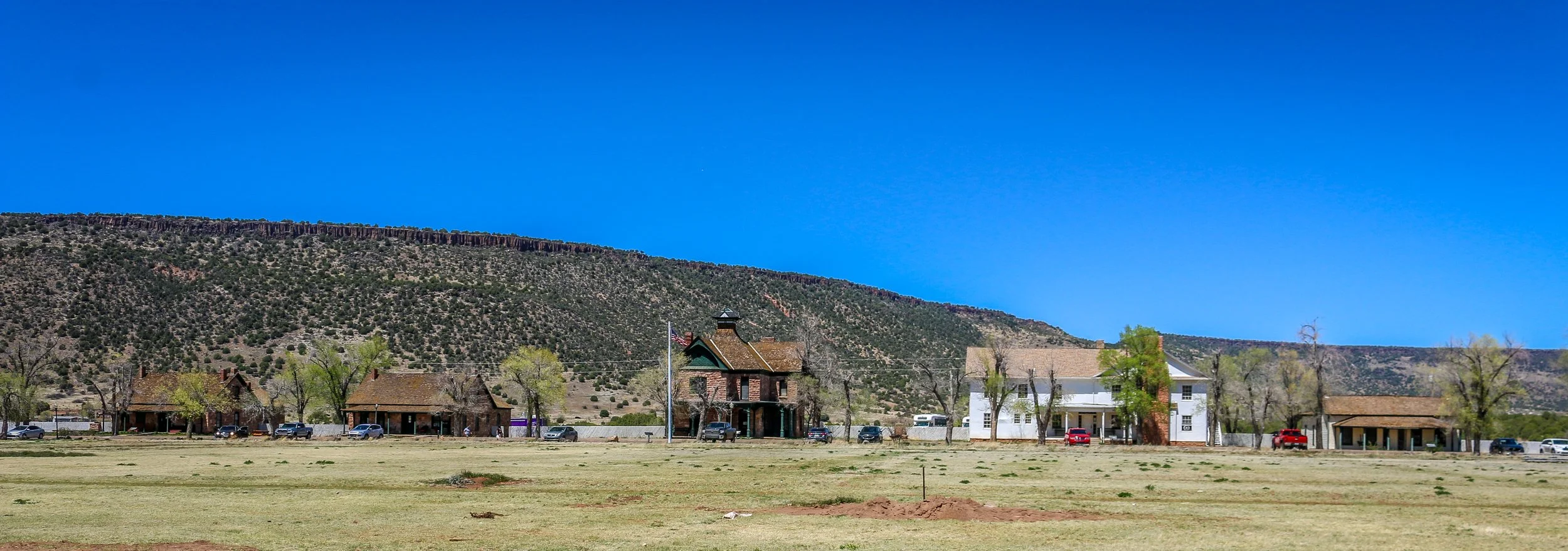
Fort Apache was constructed between 1874 and 1932 and served as an important military outpost during the Apache Wars. It rests in the midst of the beautiful White Mountains of Eastern Arizona. and is well situated at the convergence of the North and East Forks of the White River. The area is the ancestral home of the Cibicue and White Mountain Apache tribes who welcomed the United States Army to build the fort there, as they had a common enemy in the Chiricahua Apache. The White Mountain Apache are very proud of their service as scouts in the U.S. Army, and the role they played in the defeat of the Chiricahua and the capture of the great Chiricahuan leader, Geronimo. I learned a lot about the Apache Scouts and their campaigns at the wonderful "Nohwike' Bagowa" (House of Our Footprints), more commonly referred to as the Apache Cultural Center & Museum. which should be everyone’s first stop on any visit to Fort Apache.
After visiting the museum, I set off to explore the rest of the fort on a self guided walking tour which took in all of the wonderful historic buildings which remain on the post. After Geronimo’s capture in 1886, the fort remained an active military post for many years, finally closing in 1924 (although several Apache scouts remained in the army until 1947). After the army pulled out, the Theodore Roosevelt Indian Boarding School was established and the land was transferred to the Bureau of Indian Affairs as part of the White Mountain Apache Reservation. The school is still there and functioning today. I had a great visit with the kind and welcoming people of the White Mountain Apache band and really enjoyed my visit to this fascinating historic fort. I hope you enjoy these photos from Fort Apache.
I’ve spent a fair bit of time in Tombstone in my life. It was always a stop on my company’s cross-country winter trips, of which I ran many. But it was always a quick stop as we usually arrived late in the short winter day and left early the following morning, but my groups and I always enjoyed the old-west feel of the place, the dirt streets, the wooden sidewalks and having a few beers at Big Nose Kate’s Saloon. It was nice for me to get back this past winter after several years and have a little more time to spend there.
Tombstone is an old silver mining town, founded in 1877, and produced somewhere between $40 million and $85 million worth of silver bullion. During Tombstone’s heyday in the mid-1880s, the town boasted a population of 14,000 and was home to 110 saloons, two churches, three newspapers and a bowling alley. It was named the county seat of Cochise County, a designation it held until 1929. A fire in 1886 destroyed the mine’s central hoist and pumping plant and it was decided that with the productivity of the mines at that point, they weren’t worth rebuilding. The population would dwindle until tourists started to take an interest in the old west and come to have a look for themselves.
Tombstone is probably best known for the legendary shootout at the O.K. Corral between the Earp brothers and Doc Holiday and a group of cattle rustlers known as The Cowboys on October 26th, 1881.
Whenever I am driving to a new town and I don’t have a specific destination in mind, I just put the town name into my GPS and it usually brings me to either the courthouse or City Hall. Wherever it leads me is usually in the center of town and I can sort myself out from there. You can imagine my surprise, then, when I was approaching Bisbee, Arizona and I turned onto Erie Street and found myself not in the center of town, but somewhere in the 1950s. It was quite surreal to drive up the street and see nothing but classic cars, vintage gas stations and old signs with no streetlights burning and not a person in sight. My GPS told me I had reached my destination but my mind was telling me otherwise. It turned out that it had indeed led me to Bisbee’s City Hall, but that building was situated in the midst of a wonderful local art/history instillation called the Lowell Americana Project which commemorates small-town life in the 1950s.
The Lowell & Arizona Copper Mining and Smelting Company began operation way back in 1899 under the leadership of Frank Hanchett, who named his business after his hometown of Lowell, Massachusetts. Three years later, the mine would be incorporated into the Copper Queen Consolidated Mining Company. Two years after that, the town of Lowell was laid out to house local miners and their families and Erie Street became the commercial center. In 1908, Lowell was annexed into nearby Bisbee and the population would grow to 5,000 people. From what I’ve read it sounds like it was a bustling community and a pleasant place to live.
That would all start to change in 1950 when the Lavender Pit Mine was opened and the community’s population had to sell their homes and move out…
There’s much more to Winslow, Arizona than just that lyric from The Eagle’s hit song Take It Easy, but they are definitely using it to their benefit. Standing On The Corner Park at 2nd Street and Kinsley Avenue is beautifully done and brings in hundreds of tourists a day to this little town of just 10,000 or so residents. The real highlight of the town, though, is the beautifully restored La Posada Hotel, one of the original Harvey Houses opened in 1930. It is still operating as a hotel and I had the pleasure of dining in the Turquoise Room restaurant during my stay (in town, not in the hotel). There are also some great parks down by the railroad, a nice little brewery and plenty of souvenir shops. I also loved the town’s Visitor Center which is housed in the old Hubbell Warehouse which was a railroad hub for John Lorenzo Hubbell’s western trading posts. The lady working there when I visited took me around and showed me all kinds of neat artifacts from the town’s history. When I was leaving, I thanked her and with a well practiced wink she waved and said “hey, take it easy”. I hope you enjoy these photos from tiny Winslow, Arizona.