The area that is now Wickenburg was once Yavapai Indian land and the river that runs through it is the Hassayampa which means “following the water as far as it goes” in the Yavapai language. In 1863, German prospector Henry Wickenburg came to the area in search of gold. He found it and opened the Vulture Mine which would eventually produce 340,000 ounces of gold and 260,000 ounces of silver.
Ranchers came to the area as well and soon a community sprang up. In 1895, the railroad came through Wickenburg which spawned even more growth. The town was incorporated in 1909, making Wickenburg the oldest Arizona town north of Tucson and the 5th oldest in the state. In 1866, Wickenburg missed being named the territorial capital by just two votes.
Today Wickenburg is a quaint little community with a real wild west feel to it (some of the light posts are even wearing cowboy hats). There are some amazing art installations around town and the Desert Caballeros Western Museum is one of the best in the state. I love the design of the Saguaro Theatre which was also probably my favorite theatre in Arizona. You’re never alone when you’re in Wickenburg as life-like statues are spread throughout town making for a family friendly feel. I hadn’t planned on staying long in Wickenburg, but it’s a great town worth exploring and I was there way longer than I expected to be. Next time you’re in this part of Arizona, stop in for a spell. You’ll be glad you did. I hope you enjoy these photos from tiny Wickenburg - the Dude Ranch Capital of the World.
Construction on Fort Bowie began in 1862 after two separate confrontations between the United States Army and the Chiricahua Apache. The fort was erected to protect the Apache Pass through the mountains and Apache Springs, a vital water source in the area. Six years later a more substantial fort was built just up the hill from the original fort and would be in service until 1894. The Apache Wars would end in 1886 with the surrender of Chiricahua leader, Geronimo, and the removal of the Chiricahua from the area. As you may remember from a recent post, the U.S. Army was aided in this endeavor by the White Mountain Apache scouts based in Fort Apache to the north who were the sworn enemies of the Chiricahua.
The fort today is a mere remnant of what it once was. The adobe walls have all but melted back into the surrounding desert and the stone foundations and a few odds and ends are all that is left. This park is unique in that it is a “hike-in” park, meaning the only way to visit it is by hiking the 1.5 miles from the parking lot up to Apache Pass. This walk takes you past the old stagecoach stop ruins, the cemetery, an old Apache village, Apache Spring and up to the pass where the fort is located. While the rangers at the park will provide access for people with disabilities, this walk is an amazing way to get a feel for the remoteness of the fort and the isolation the men who were once stationed there must have felt. I was definitely glad I visited in the winter months as I’m sure making this walk in the summer is quite hot and dusty. I was definitely glad I finally made it out to Fort Bowie as it’s been on my to-do list for many years now and I’m glad I finally got there. I hope you enjoy these photos from Fort Bowie National Historic Park.
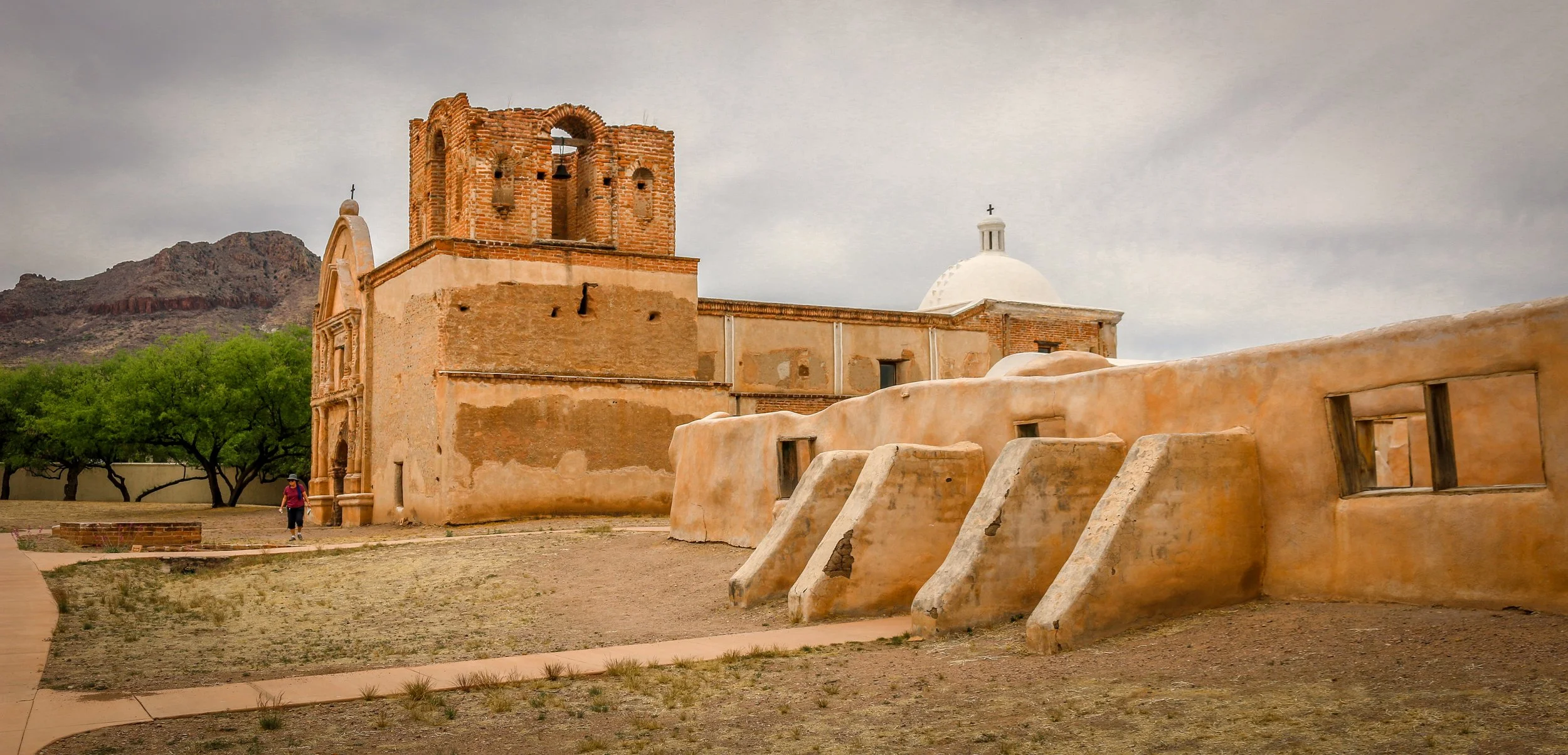
Father Eusebio Francisco Kino established the Mission San Cayetano de Tumacácori on the east side of the Santa Cruz River in January of 1691, making this the oldest mission site in what is now Arizona. The name “Tumacácori” is an English bastardization of a Spanish interpretation of an O’odham (Pima) word, the meaning of which has been lost. It is how the native people referred to this region. After years of violence at the hands of the Spanish, the O’odham people rose up in the Pima Revolt of 1751. Laying blame on the abuse of the Jesuits missionaries, they were pardoned by the colonial governor and the Jesuits would be expelled from the colonies beginning in 1757. The mission was moved across the river and renamed Mission San José de Tumacácori and the first actual church was built on this new site.
Franciscans would try and pick up where the Jesuits left off and in 1800 they began work on an ambitious new church, trying to match the majesty of Mission San Xavier del Bac to the north (a photo of which appears at the very bottom of this post). The church was never fully completed as the missions were closed when the Mexicans won their independence in 1821. Today, the mission is a part of Tumacácori National Historical Park and a visit is a must when you’re in the area. You can learn more about the O’odham people, the Spanish missionaries and colonial life in the missions and it’s a very cool place for a wander.
I’ve spent a fair bit of time in Tombstone in my life. It was always a stop on my company’s cross-country winter trips, of which I ran many. But it was always a quick stop as we usually arrived late in the short winter day and left early the following morning, but my groups and I always enjoyed the old-west feel of the place, the dirt streets, the wooden sidewalks and having a few beers at Big Nose Kate’s Saloon. It was nice for me to get back this past winter after several years and have a little more time to spend there.
Tombstone is an old silver mining town, founded in 1877, and produced somewhere between $40 million and $85 million worth of silver bullion. During Tombstone’s heyday in the mid-1880s, the town boasted a population of 14,000 and was home to 110 saloons, two churches, three newspapers and a bowling alley. It was named the county seat of Cochise County, a designation it held until 1929. A fire in 1886 destroyed the mine’s central hoist and pumping plant and it was decided that with the productivity of the mines at that point, they weren’t worth rebuilding. The population would dwindle until tourists started to take an interest in the old west and come to have a look for themselves.
Tombstone is probably best known for the legendary shootout at the O.K. Corral between the Earp brothers and Doc Holiday and a group of cattle rustlers known as The Cowboys on October 26th, 1881.
Nara Visa, New Mexico got its start as a rail town when the Chicago, Rock Island and Pacific Railroad was being built around the turn of the 20th century. It was originally called Narvaez after a local family who had farmed in the area for decades, but was eventually anglicized to some degree to Nara Visa. Within a decade, the town had grown to include 4 churches, 8 saloons, a couple of hotels and a whole array of small businesses. In 1921, with a growing population of 651, a fine school was built and the Works Progress Administration helped add a gymnasium a decade and a half later. The depression took its toll on the town though and lean years were ahead for Nara Visa. By 1968, there were only 7 students enrolled at the school when it closed its doors for the last time. Today less than a hundred people call the town home, and none of the businesses from this once thriving little community are open. It’s easy to pass through Nara Visa and not see it at all. I’m glad I got out and had a look. It makes me sad when towns die, but the reality is that everyone leaves at some point, one way or another. It looks like times were good there once, and maybe will be again at some point in the future. It sure made for some nice photos though. I hope you enjoy these photos from Nara Visa - a modern day ghost town in eastern New Mexico.
“The Original Las Vegas” was founded along the Galinas River in 1835 in the midst of Mexican rule in the area and quickly grew as a popular stop on the Santa Fe Trail. It was on the Plaza in Las Vegas where Stephen Watts Kearny claimed New Mexico for the United States during the Mexican-American War in 1846. In 1879, the Atchison, Topeka and Santa Fe Railroad came to Las Vegas and the town quickly grew into one of the largest in the region. The New Mexico Normal School (now Highlands University) was established in 1893 and Fred Harvey built the Castañeda Hotel in 1898 as part of his hospitality empire in the southwest. Las Vegas hosted Teddy Roosevelt’s Rough Riders’ first reunion in 1899, a tradition that continued for many years. In more recent years, Las Vegas has been the filming location for many movies including No Country For Old Men, Wyatt Earp (with Kevin Costner), and perhaps most notably for me, Red Dawn where it served as the fictional town of Calamut (the massive “Calamut Says Howdy” mural is still a prominent feature downtown). I found Las Vegas to be a quiet, charming University town with some spectacular architecture, fascinating history and friendly people. It may be the “other Las Vegas”, but it’s a town not to be missed on your travels in New Mexico. I hope you enjoy these photos from wonderful Las Vegas, New Mexico.
Native Americans mined turquoise in the hills which now surround the tiny town of Cerillos. In more recent times, miners have also found gold, silver, copper, lead and coal in the area. An early Spanish explorer commented on the mineral wealth in these “little hills”, which gave the town its name. While all of the things that are mined in the area are valuable, it was the 1879 discovery of gold which really put Cerillos on the map. The railroad came through the following year and the town boomed. The town’s population grew to over 3,000 and it supported 21 saloons, 4 hotels, 3 churches, an opera house and several newspapers. At one point, Cerillos was even in consideration to be the capital of New Mexico and was visited by Teddy Roosevelt. With every boom comes a bust and by 1930 most of the big mines had closed, although turquoise is still mined nearby and is considered some of the finest in the country. The dirt roads and old buildings of Cerillos have made it a great Western filming location with Walt Disney's Nine Lives of Elfego Baca and Young Guns being two of Cerillos’ most famous productions. I’ve probably seen Young Guns several dozen times, so Cerillos felt familiar as I walked the streets and when I saw the faded Murphy-Dolan Store sign on the side of the old Wortley Hotel it really made me smile. Cerillos is a great little turn-off from the Turquoise Trail Scenic Byway which connects Albuquerque and Santa Fe and I definitely enjoyed my visit. I hope you enjoy these photos from the old mining town of Cerillos.
Madrid was the first town I came to along the beautiful Turquoise Trail, the scenic byway which connects Albuquerque and Santa Fe. Pronounced MAD-rid for some maddening reason, I couldn’t find a clear story as to how the town got its name. The earliest Europeans in the area most likely came from Spain, but it doesn’t appear that Madrid got its name until New Mexico was an American territory. First lead and then coal were mined in the surrounding hills and in 1892 a 6 mile spur was built to connect the town to the Santa Fe Railway. By 1906, coal mining in the area was consolidated under the Albuquerque and Cerrillos Coal Company and a company town grew to a population of over 3,000, more than that of Albuquerque at the time. In 1922, Madrid boasted the only baseball field with lights west of the Mississippi River, and the Brooklyn Dodgers’ minor league affiliate the Madrid Miners played there for many years. The mines did well until the early 1950s and in 1954 the Coal Company left Madrid and many of the residents went with them. By the early 1970s, Madrid was almost a ghost town but then artists discovered the town and started moving in. Today, Madrid is a vibrant and colorful town with many reminders of the old mining town that it once was, but truly reborn as an artists’ colony and a tourism destination. I hope you enjoy these photos from beautiful Madrid, New Mexico.
Native Americans have been passing through the area we now call the Salinas Valley for thousands of years. As agricultural techniques developed, hunter-gatherer societies began to settle down, plant crops and build permanent communities. The communities which grew in the Salinas Valley combined the traditions of the people we call Mogollon with those of the Ancestral Puebloans. They traded with other Puebloan groups to the west and with the Plains Indians to their east.
When the Spanish arrived in 1540, Coronado was searching for the 7 Lost Cities of Gold. He never found gold, but found abundant salt deposits in these mountains which is where they get their name (“salinas” means “salt” in Spanish). While the treasure seekers were met with disappointment, the Franciscan priests who accompanied them found whole towns of souls they believed needed saving. They took up residence in these remote pueblos and oversaw the construction of massive churches. They brought with them items which changed these societies for the better like wheat, fruit, cattle, goats and sheep. They also brought disease and demands for the Native people to give up their rituals and traditions. Some of these pueblos contain kivas, the underground centers of Pueblo communities and religion which point to some level of compromise, since later missions had kivas filled in and destroyed. Spanish priests and governors were often in disagreement over how to treat the Puebloan people, and cultural conflicts would often erupt…
In 1598, Juan de Oñate y Salazar was on a conquest to colonize Nuevo Mexico for Spain. Traveling north of El Camino Real, his caravan had just passed through the dreaded 90 mile stretch known as the Journada del Muerto or “Journey of the Dead Man” when they encountered the Piro people of the Tempana Pueblo. These people offered the party food and water and Oñate called the place “Socorro” meaning succor or aid. In 1626, the Spanish built a mission church nearby and christened it Nuestra Señora del Perpetuo Socorro or Our Lady of Perpetual Succor. The mission was abandoned and destroyed during the Pueblo Revolt of 1680 and wouldn’t be resettled until 1815. A beautiful new church was built and named after San Miguel.
I came to Socorro because it was where I was when I ran out of steam for the day. It was on my radar, but I didn’t know if I would have time to stop. I’m sure glad I did. There are so many wonderful historic buildings around town, and the evening was absolutely perfect for photography. I enjoyed a nice long walk around downtown and then settled into the mining-era Capitol Bar for a couple of their house-brewed beers. Then I ventured out to El Camino Restaurant and Lounge, a holdover from another time. Both the restaurant and the lounge are worth visiting for the ambiance alone. It snowed overnight and while there wasn’t much on the ground, the mountains had a lovely dusting. I happily snapped a few more shots with the snow before hitting the road. Socorro is definitely worth a stop on your way through New Mexico and I hope you enjoy these photos from my brief time in this wonderful little town.
People have been visiting the natural hot springs in the Palomas Basin for centuries. The Spanish called them Ojo Caliente de Las Palomas and the cowboys called them Palomas Hot Springs. In the late 18th century, a public bath was built on a ranch in the area where people could come and take the waters. When the Elephant Butte Dam was built in 1912 to help with irrigation, the area became more attractive to settlers and the town of Hot Springs, New Mexico was incorporated in 1916. Twenty-one years later, it would become the county seat of Sierra County. In 1950, Ralph Edwards, the host of the popular radio show Truth or Consequences, promised to air their 10th anniversary show live from any town that would change its name to match that of the show. Hot Springs residents jumped at the opportunity and officially changed its name to Truth or Consequences. Edwards made good on his promise and visited the town on the first weekend of May every year for the next 50 years. His visit was turned into a celebration, Fiesta, which still happens every year at that time. T or C, as the locals call it, is a wonderful and colorful little town full of hot springs resorts and art galleries and with a backdrop of beautiful mountains that light up when the sun is low in the sky. I loved my brief stay in one of the country’s most uniquely named towns, and I hope you enjoy these photos of fabulous Truth or Consequences.
The homes we now refer to as the Gila Cliff Dwellings were built beginning around 1276. The rivers in the area provided a constant source of water, a necessity in the desert and probably the reason the people who built these dwellings chose this location. While they were contemporaries of the people we now call the Ancestral Puebloans, differences in their construction styles, pottery and art have caused archaeologists to give them a different name and we refer to them as the Mogollon. The time that the Mogollon spent in these dwellings, approximately 25 years, coincides with prolonged drought in the area which caused many groups to move in search of water. It seems that the Mogollon moved into these alcoves near the beginning of the drought, and left as it was ending. When looking at history, it’s easy to think of 25 years as the blink of an eye, but it’s a whole generation of children growing to adulthood and having their own babies and adults moving into the roles of elders as elders pass on. There was love and loss and laughter as this group passed the time farming, hunting, building, creating and growing.
The Mogollon seem to have moved on around 1300 as the drought was coming to its end and these isolated dwellings likely remained empty for quite some time. The Chiricahua Apache migrated to the region in the 1500s and the great leader Geronimo was born near the headwaters of the Gila River around 1820. Spanish settlers came to the area in 1598, but there is no evidence they penetrated the wilderness anywhere near to the dwellings. Prospector H.B. Ailman documented the cliff dwellings in 1878 and by the time archaeologist Adolph Bandelier arrived in 1884, looters had ransacked the alcoves and made off with whatever artifacts were to be found. Homesteaders, miners, prospectors and ranchers arrived over the next few decades and President Theodore Roosevelt protected the area as Gila Cliff Dwellings National Monument in 1907. Not too long after he did, Aldo Leopold came to the region as a forester and lobbied the Forest Service to establish the GIla Wilderness, the first designated wilderness area in the country and an inspiration for the 1964 Wilderness Act.
Today, the Gila Wilderness is a quiet and magical place. It’s a two hour drive from Silver City, the nearest town of any real size, to the Cliff Dwellings. The road that brings you in is the aptly named Trail of the Mountain Spirits National Scenic Byway and it is a truly beautiful drive. During my visit, I toured the cliff dwellings, scouted out some beautiful pictographs, hiked the fabulous Little Bear Creek Canyon trail to the Middle Fork of the Gila River and soaked in wonderful hot springs. I loved my time in the Gila Wilderness and hope you enjoy these photos from my visit.