Hello Everyone! It’s been a little quieter out here on the road this week than the last few weeks. I’ve tried to slow down a little and get some fishing in while I’m here and the warm weather is too. Unfortunately, I’ve also managed to catch a cold this week which has only slowed me down further. I’ve caught this cold even with all the hand-washing and masking and being careful which just goes to show how easy it is to pass things along. I’ll be laying low for a couple of days, hydrating and getting some sleep and hopefully it’ll pass on through sooner rather than later. This week brought me from the middle of Wisconsin’s section of the Great River Road to the heart of the Northwoods, and it’s been a really wonderful week which I can’t wait to tell you about.
When I left you last week, I was in La Crosse which really is quite a nice little city. There are lots of old buildings and corner bars and with a reasonable sized student population it felt very vibrant and alive. Last Wednesday night I went for a cruise on the La Crosse Princess, a sternwheel paddleboat that does several different tours on the Mississippi River. I went on a short 90 minute beer and pizza cruise which was definitely a bargain at $21. It was nice to be out on the river, and that length of time was just about perfect for my attention span. The weather was perfect and I really enjoyed it. After the cruise I went and saw some live music at Big Al’s downtown which was great and sat with a wonderful older lady who was very into the live-music scene. It was very kind of her to ask me to join her. We had a nice chat and enjoyed some good music and she invited me out the following night to a different venue.
Thursday I spent a good chunk of time in the library, trying to get a jump on some work for this week. In the afternoon I drove up Grandad’s Bluff, La Crosse’s most well-known geologic feature. The road took me right to the top for wonderful views out over the city and the Mississippi River. It was cool and quiet up there and I stayed up on top for quite some time. Later that evening I went for a stroll along the Mississippi and then to a wonderful night of live music at the amphitheater right there on the river. It’s getting a little cooler out and it was nice to just sit outside and have a beer and enjoy the music. The band was good and I stayed right up until the end. Afterwards I joined my friend from the previous evening at the old train station for a really good grandfather-grandson duo and met her boyfriend and granddaughter. When the band finished up, I took one last stroll around town and then called it a night.
Friday morning I was up and off and headed north along the Great River Road. I stopped in the small and charming river towns of Trampealeau and Alma for a while and found a nice apple orchard along the way to pick up some fresh apples which are just coming into season up here. Then I headed on to Nelson for lunch under the Twin Bluffs and an ice cream at their wonderful creamery. From there, I moved on to Pepin which is best known as the birthplace of Laura Ingalls Wilder.
Washington Island is just a quick 30 minute ferry ride from the tip of the Door County Peninsula, but you have to cross Death’s Door to get there. The story I heard was that Potawatomie and Winnebago (now referred to as Ho-Chunk) Indians occupied opposite sides of the passage. One day they both sent war parties in boats to attack the other side but a storm came up and killed all of the warriors who set out that day. When they later recalled this story to French trappers, the passage was named Porte des Mortes or Door of Death. This is where Door County gets its name.
I had a wonderful visit to Washington Island and crossed Death’s Door twice without incident. The island is a pretty good sized rock and traces much of its European heritage back to Scandinavia. I read that Washington Island has the highest concentration of Icelandic-Americans in the country. I learned about some of the island’s cultural history at the Jacobson Museum and some of its fishing and boating history at the Maritime Museum. At Nelson’s Hall the bartender told me that the proprietor got his pharmacy license during Prohibition and served up straight 90-Proof Angostura Bitters to his patrons as “stomach medicine”. Now you too can join the “Bitters Club” by doing a full shot of it yourself (which obviously I did). Nelson’s is the top seller of Angostura Bitters in the country. Next door at K.K. Fiske’s you can enjoy a fresh grilled “Lawyer” or Burbot fish, although sadly they didn’t have any there for me during my visit. The Stavkirke is a beautiful recreation of a traditional Norwegian Stave Church and is really quite breathtaking to see and definitely one of the top highlights on the island. There are other cool Scandinavian buildings around as well and many people proclaim their heritage with that country’s flag on their mailbox. I spent a lot of time at Schoolhouse Beach which is a beautiful protected harbor on the north side of the island which boasts a beach made up of perfectly smooth stones. If you’ve followed me long enough, you know I have a special place in my heart for islands and will explore them whenever the opportunity presents itself. I really enjoyed Washington Island, especially since I could bring my van out there with me. I only wish it had been sunnier while I was there so you could really see how beautiful it was, but the weather is what it is when I am where I am, and it was pretty cloudy during my stay on the island. I hope you enjoy these photos from beautiful Washington Island because I had to cross Death’s Door to get them.
The Keweenaw Peninsula juts north from Michigan’s Upper Peninsula far out into Lake Superior. The word “Keweenaw” comes from an old Ojibwa word meaning “a place where portage is made”. This area is home to one of the richest copper deposits in the world and has been mined for thousands of years. After Michigan became a state in 1837, prospectors started making their way into the Keweenaw and copper claims and mines were quickly established. These mines were often in operation until World War II. Around these mines, communities grew which were often settled by immigrants eager to build a life in the new world. Mining was dangerous work, but the promise of a decent wage was enough to lure people to this isolated northern region. When the price of copper dropped and the mining process was no longer profitable, whole communities packed up and moved elsewhere and once-bustling towns were quickly reclaimed by the forest. Some towns remain today, but many are struggling and reliant on tourism. I loved this region and spent a little over a week exploring its history and towns. I toured the Quincy Mine and enjoyed wandering around Houghton, Hancock, Calumet, Eagle River and Copper Harbor. I included a few photos from nearby Marquette as well since it traces its roots to the same time period. The whole region is now a part of Keweenaw National Historical Park and Keweenaw National Heritage Area and you can find the Visitors Center in downtown Calumet. I hope you enjoy these photos from the beautiful Keweenaw Peninsula, Michigan’s Copper Country.
The Ojibwa Indians called Isle Royale “Minong” meaning “a good place to be” and they certainly hit the nail on the head with that one. Isle Royale National Park consists of Isle Royale itself and over 400 smaller islands making up an archipelago in the middle of Lake Superior. Isle Royale is the largest natural island on Lake Superior and the second largest in the Great Lakes at 45 miles long and 9 miles wide. Some of Michigan’s earliest copper mines were established on Isle Royale in the 1840s, continuing the Ojibwa copper-mining tradition which stretched back hundreds of years. Commercial fishing operations also ran off of Isle Royale for many years, but it was the island’s beauty and ability to attract tourism which would create its lasting industry. Isle Royale National Park was established in 1940 and it was made a part of the UNESCO International Biosphere Reserve in 1980.
I had a wonderful 4 day/3 night visit to Isle Royale in the beginning of August. The island is only accessible by boat or plane, with ferries originating out of Houghton and Copper Harbor in Michigan and Grand Portage in Minnesota. I chose the Isle Royale Queen IV out of Copper Harbor which dropped me off in Rock Harbor on the island’s northeast side in about three and a half hours. After getting my backcountry permit from the ranger there, I headed off into the wilderness for the next three nights, staying at Daisy Farm, Lynn Cove and Three Mile campgrounds. I hiked about 25 miles during my time on Isle Royale and really found the island to be a beautiful place to be. After hiking all day, an afternoon dip in Lake Superior always felt great. I saw 9 moose during my visit and also a handful of beavers along with plenty of birds and toads. I really cherished my time on Isle Royale and hope you enjoy these photos from America’s least visited National Park.
Cheboygan was incorporated in 1871 and grew up around the timber industry, supplying wood for the westward expansion of the country. Located at the confluence of the Cheboygan River and Lake Huron, the town became known as the “Gateway to the North”, although now it goes by “Historic Rivertown” as well. Because of its location and proximity to the Mackinac Bridge and Mackinac Island, Cheboygan certainly sees its fair share of tourism, yet it maintains its small-town feel and felt more like a real, lived in town than many of the places I visited in the state. With two beautiful lighthouses and as the home port of the Coast Guard Icebreaker Mackinaw, Cheboygan maintains its maritime history as well. I had a wonderful time in Cheboygan and only captured some of the beautiful places the town has to offer, but it’s definitely a town worth seeing - ether as a less touristy gateway to the region or in its own right. I hope you enjoy these photos from my time in beautiful Cheboygan.
Hello Everyone and greetings from Copper Country. I’m coming to you this week from the Keweenaw Peninsula – the northern peninsula of Michigan’s Upper Peninsula. This area is known historically for its incredibly rich copper loads which were mined from the 1840s right up until World War II. The towns up here certainly have traces of their former glory, though when the copper industry left, so did most of their economy. Today they depend more heavily on tourism as people come here for mining history and beautiful Lake Superior beaches in the summer and hunting in the fall. It’s a fascinating region and one that I’ve really been enjoying. I actually came up here once or twice as a kid with my dad, so there is some vague familiarity to it, but it’s definitely all new ground for me as an adult. When most of y’all are reading this, I’ll be out on Isle Royale where I’ll be spending three nights in America’s least visited National Park. I’ve been looking forward to going to Isle Royale for a very long time, and I hope to come back with some great photos and stories to tell. Since I’ll be catching the ferry bright and early Wednesday morning, I’m going to finish up with this week’s This Week post a little earlier than usual. That being said, even with a short week, I’ve certainly seen and done a lot so let me tell you what I’ve been up to.
When I left you all last week I was on my way out of Munising after two wonderful days in Pictured Rocks National Lakeshore. I headed south from there to Manistique, a pretty little town on the northern shores of Lake Michigan. I got there just before it started to rain and it rained through the night. I spent the night at the casino just outside of town and won about $50 playing quarter keno.
Thursday morning was gloomy so I was in no big rush to get up and moving. When I did I went down to the beach to eat my breakfast and then wandered out on the breakwater to see the Manistique Lighthouse, which is still active. Dark red in color, the lighthouse really stood out against the grey background of the sky. I took a quick dip in the lake which woke me up more than my coffee did and then headed out of town. I ventured up to Palms Book State Park, home of Kitch-iti-kipi Spring, the largest of Michigan’s freshwater springs. Big Spring, as it is also called, pumps out 10,000 gallons of water every minute at a constant 45 degrees Fahrenheit and is about 40’ deep in the center. The water is a beautiful greenish turquoise and was really quite something to see. The park loads passengers onto a huge raft with a glass floor in the middle so people can look down into the spring, but there were so many people there in line that I decided to pass. I enjoyed the view from the shore and will wait for the raft adventure for another time.
From there I headed out onto the Garden Peninsula which juts out into Lake Michigan and protects Big Bay de Noc on its western side. About 20 miles down on the bay side is Fayette State Historic Park which I thought was really cool. During the second half of the 19th century, Fayette was an iron smelting town, turning raw iron ore into pig iron in its giant furnace. The town attracted immigrants to work at the furnace and in its heyday had a population of around 500. When the furnace shut down in the 1890s, the town was all but abandoned except for the hotel which operated until World War II and the post office which served the area until the 1950s. The town was eventually acquired by the state of Michigan and now serves as an historic site interpreting life in a 19th century company town. Some of the old buildings are still standing, some have been restored or rebuilt altogether while some are nothing but ruins. By the time I reached Fayette, the weather had cleared and it turned into a beautiful day – perfect to explore this old town site. I thought it was a really interesting place and definitely worth a visit.
Beaver Island is the largest island in Lake Michigan and is home to a year-round population of around 650 people. Beaver Island has an interesting history for such a small place. It was originally settled by Irish immigrants, but in 1848 a group of Mormons, led by James Strang, came to the island and took up residence. After the death of church founder Joseph Smith, most Mormons recognized Brigham Young as his successor, but a small group known as “Strangites” believed Strang should lead the church. They named the main town St. James in his honor and he declared himself king of the island, pushing many of the original Irish settlers who wouldn’t convert back to the mainland or to Mackinac Island. In 1856, Strang was assassinated by two of his former followers as he walked down the main street in the town named after him. When news of his death reached the mainland, the Irish exiles returned to reclaim “their” island. More Irish immigrants would come to Beaver Island after being exiled from their island of Arranmore in County Donnegal and many of their descendants still live on the island today. I only spent one night on Beaver Island, but it was long enough to explore the St. James area and get a feel for the island and its people. If I had another day, I would have rented a car and gone further afield, but it was still a nice day.
I love islands and their distinct characteristics and quirks, and Beaver Islands was no exception. The islanders like to use the word “boodling” which I’ve seen loosely translated as “to roam in a carefree and loosely structured manner, often with beer”. Apparently they sometimes boodle by throwing a picnic table in the back of a pickup truck (somehow legal on the island), and drive from place to place enjoying beers and snacks. The next time I’m there I will have to try it out. I really enjoyed the two museums on the island - one about local history and the other about the maritime history of the island (the docent there said I got the record for most time ever spent in that museum). I happened to be there during Museum Week which meant that the night I was there had a performance called Music on the Porch, which brought out the island’s musicians to perform from the porch of the old Mormon Print Shop (the local history museum). It was wonderful to be a part of and I really admired those who were perhaps less talented who still got up to perform. I had a great time out on Beaver Island and I hope you enjoy these photos from Michigan’s Emerald Isle.
South Haven, Michigan is a charming little port town where the Black River flows into Lake Michigan. Originally inhabited by the Potawatomi people, the first settlers arrived in the 1850s. Like many towns along this coast, South Haven started out as a lumber town, supplying the trees to build the towns as the United States expanded westward. As the trees were cleared, farmers took advantage of the open fields to plant fruit, and the area grew to be a major supplier of fruit to the Great Lakes region and beyond. Today there is still plenty of traffic moving up and down the Black River and in and out of Lake Michigan, but South Haven has also made tourism a major industry. The beach is warm and welcoming, the downtown area is clean and lively and there is definitely plenty to keep you busy on a short or long stay. Of course, sunset is the highlight of every day along the Sunset Coast of Michigan. I was there over the 4th of July weekend and while it was probably busier than usual, South Haven maintained its small-town cool and handled the busy weekend well. I really enjoyed my stay in South Haven and hope you enjoy these photos from my visit.
Tiny Marshall, Michigan sure has a lot to see in a very small area. Most of the downtown area is part of the National Historic Landmark District which includes over 850 buildings, a staggering amount for a town of just 7,000 people. It is not easy to maintain a town in the condition Marshall is in, and I really take my hat off to those who are working so hard to keep it the way it is.
Marshall was founded in 1830 and grew as a transportation hub catering to road, rail and river travelers with several historic inns and restaurants in the city dating back to those early days. The town was named for U.S. Supreme Court Justice John Marshall and of the more than 20 towns named after Marshall, this was the only one so-named before his death. Marshall became an early innovator in the public schools movement and their model was copied across the country. The town was also one of the final contenders to become the State Capital when it was moved from Detroit, but lost out to Lansing in the end.
Today, Marshall is incredibly well maintained. I loved that I could pick up a map outside of their tourism office at any time of day and the music playing on the street made me smile. There were historic walks laid out on the map, and markings on the sidewalks to help guide you along. The buildings downtown were well preserved and some truly transported me back in time. The homes in the surrounding neighborhood were equally historic and also well cared for. My favorite was Honolulu House which offered a wonderful guided tour. I came to Marshall planning on spending an hour and ended up there for more than half the day. It was definitely the cutest town I saw in all of southern Michigan and I am definitely looking forward to returning in the future. If Marshall isn’t on your list of Michigan small towns to visit, it certainly should be. I hope you enjoy these photos from beautiful Marshall, Michigan.
Hello Everyone. It’s been a sunny and beautiful week here in Michigan, and I’ve been out exploring the peninsula that juts out into Lake Huron and is lovingly referred to as “The Thumb” of the state. If you’ve never looked closely or thought too much about it, Michigan is shaped like a mitten, and if you ever meet someone from Michigan they will inevitably point out wherever they are talking about on their hand, which is really quite endearing and very Midwestern. It is a quiet and less populated part of the state with some great small towns and tremendous lake views. I finished off the week with a run of old industrial towns and the Bavarian village of Frankenmuth. It’s been considerably cooler this week and it’s often been down in the 50s when I’m going to bed which is just perfect for me. I’ve seen some great spots this week and I can’t wait to tell you all about it.
When I finished this post last week, I headed out of Port Huron and made my way north to the quaint little lakeside town of Lexington. I spent some time wandering the streets and taking some photos which you can see here. I thought it was a great little place and I really enjoyed my stroll. From there I moved up the coast through Port Sanilac to Forester Park. I don’t normally stay in campgrounds, but I decided I wanted to stay on the lake for a couple of nights and not worry about it. When I went to make the bookings, this site looked like it was right on the lake, but on arrival it was actually behind a row of private homes which blocked any possible view of the lake. The map was somewhat deceiving and I was pretty disappointed with the whole thing. Soon after pulling in, I got word that my very good friend’s father passed away, and while it wasn’t sudden or unexpected, it was still hard news to get, especially just days before Father’s Day. It was a bit of a rough afternoon and I went for a walk around the campground to clear my mind a bit. When I came back to my site, there was a big 5th Wheel pulled in right next to me. I introduced myself to the man who it belonged to and we had a wonderful chat for an hour or so. I really needed a bit of companionship in that moment and just like that, it was there. I felt a whole lot better afterwards and cooked up some dinner which I enjoyed from the picnic area which was overlooking the lake.
Thursday I meandered up the coast and spent some time in Harbor Beach, a town with a massive manmade harbor which was built to provide a safe haven for ships caught out in bad weather between Saginaw Bay and the St. Clair River at Port Huron. The town had a nice lighthouse, a pretty little beach and a long pier out into the harbor. I enjoyed a stroll to the end of the pier and then went for a wander around downtown. I particularly liked the library which had an incredible set of murals on it which paid tribute to local history and people. It seems the most famous person to come out of Harbor Beach was Frank Murphy who served as Mayor of Detroit, Governor of Michigan, Governor General of The Philippines, Attorney General of the U.S. and finally as a justice on the U.S. Supreme Court. During World War II he was serving on the high court and moonlighting as an army officer (seriously). Apparently his most noteworthy action on the court was writing the descent against the internment of Japanese-Americans during the war which he called out for the blatant racism which it absolutely was. Harbor Beach was interesting and learning about Murphy was as well.
In the afternoon, I headed further up the coast to Lighthouse County Park, right where the thumbnail would be on The Thumb. Everything that Forester Park wasn’t, Lighthouse Park was and then some. My campsite was right on the lake with an expansive view in every direction. It was just beyond the shadow of the Pointe Aux Barques lighthouse and right on the outside edge of the park...
Port Huron is a lovely mid-sized town where Lake Huron empties into the St. Clair River. Originally inhabited by the Ojibwa people, the site was settled during the War of 1812 with the establishment of Fort Gratiot. People moved to the area for jobs in the lucrative lumber and shipbuilding industries. While he was born in Ohio, Thomas Edison spent his formative years in Port Huron, selling candy and newspaper on the Grand Trunk Railroad route to Detroit. Today, Port Huron is a quiet town with a beautiful lighthouse, a charming downtown area and a wonderful riverfront walk that takes you right under the Bluewater Bridge which connects Port Huron to Sarnia, Ontario. I had a great stay in Port Huron and absolutely stunning weather while I was there. I hope you enjoy these photos from my time in this lovely waterfront town.
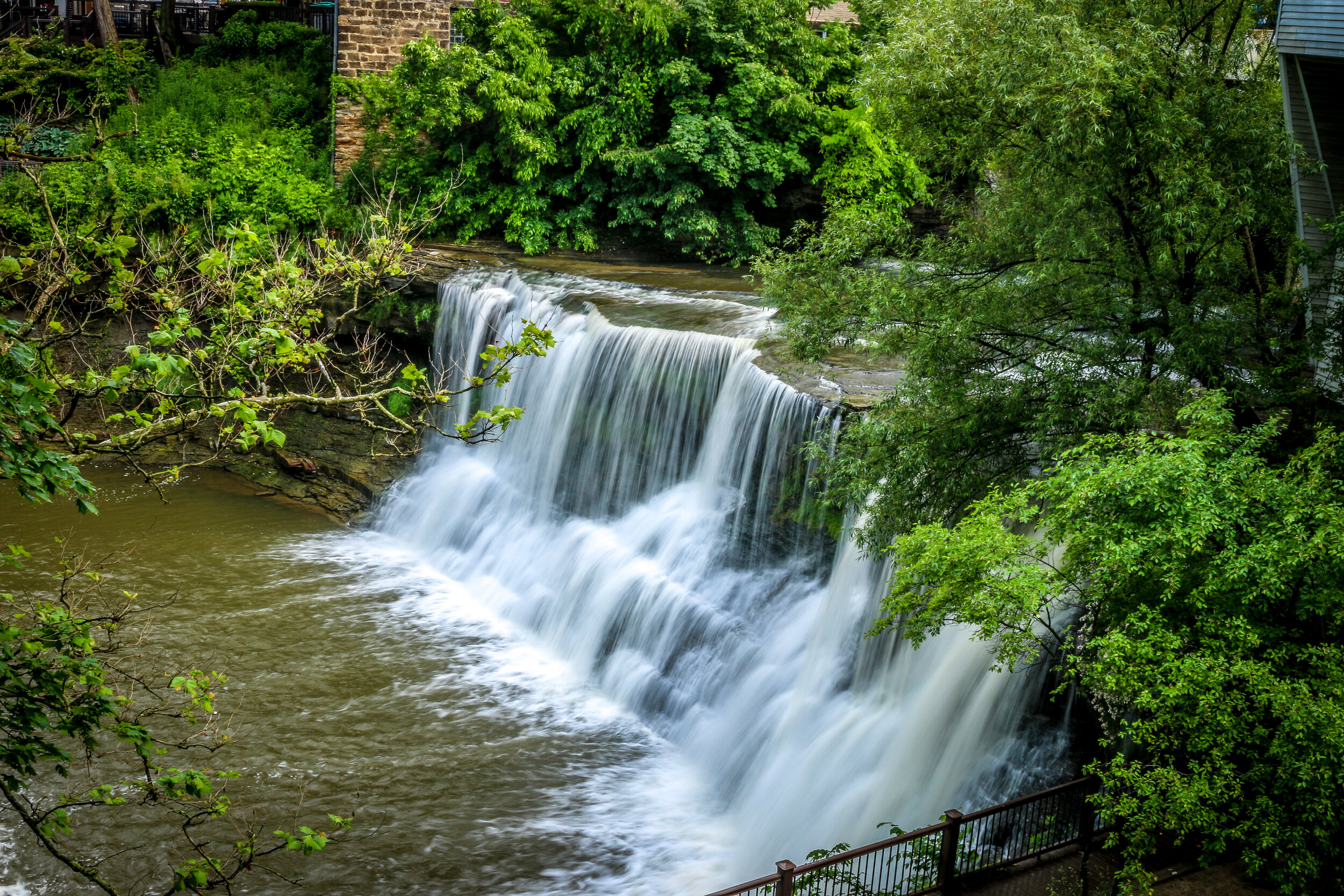
Chagrin Falls is a charming little town in the outer suburbs of Cleveland, Ohio. The Chagrin River runs through the heart of town and once turned the waterwheels of early industry here. The namesake falls are quite stunning and there are nice viewing platforms on either side of the river. There are some wonderful art projects around, including the crocheted trees at the art center that stopped me in my tracks. Chagrin Falls is full of adorable local businesses, none more-so than the Chagrin Falls Popcorn Shop pictured above. My very good friend Mike Vasko lives in Chagrin Falls, so I’ve been fortunate enough to visit more than once. It really is a wonderful place and if you’re ever in the area, stop through for a wander. I hope you enjoy these pictures from the tiny town of Chagrin Falls, Ohio.