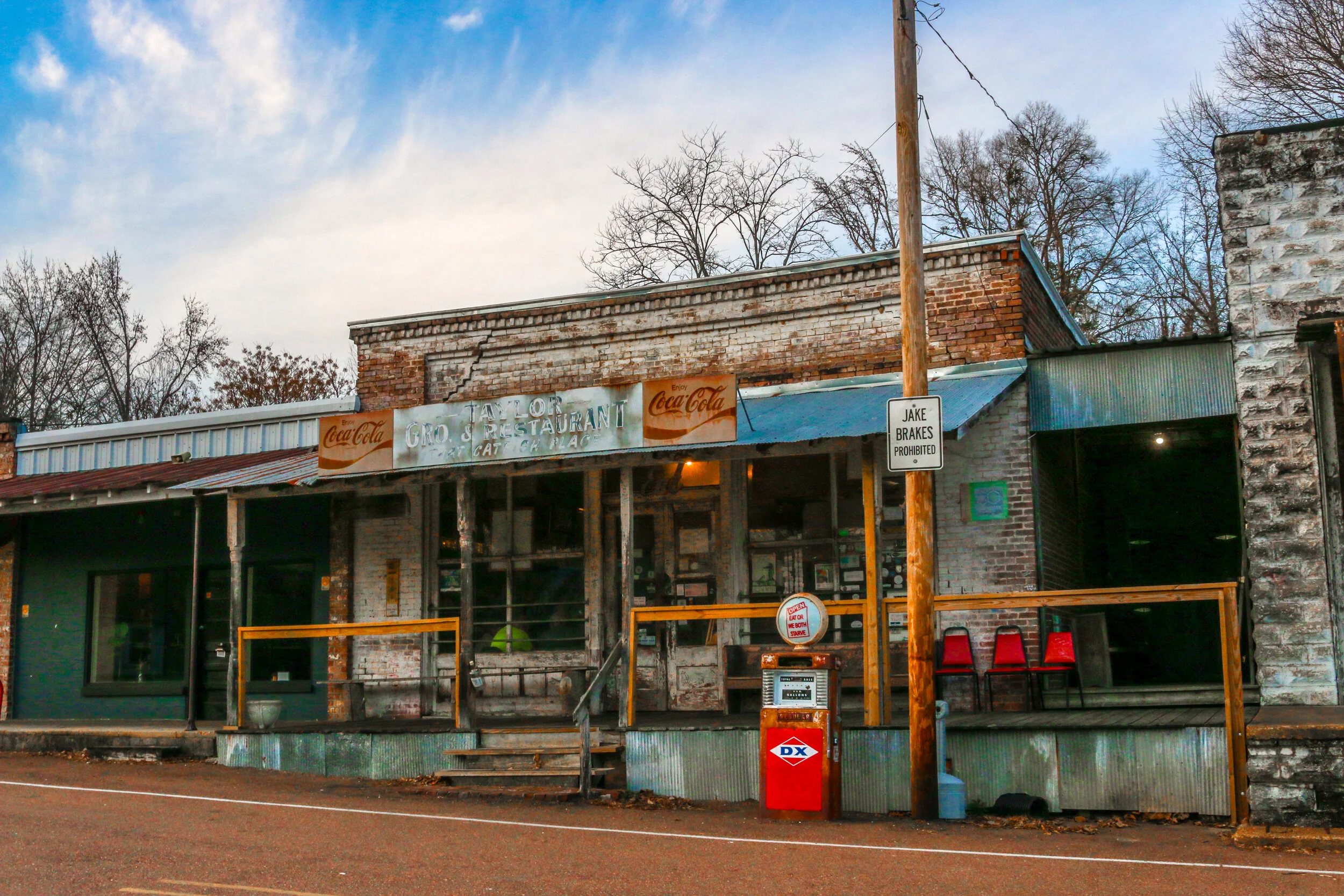
Give me an out-of-the-way place with history, visual appeal and live music and I’m a happy man. Throw in good company and great food and I could be there for awhile. Such was the case on my recent visit to historic Taylor Grocery in tiny Taylor, Mississippi, which is only about 20 minutes from The Square in downtown Oxford, but feels a world away.
During my stay in Oxford, I spent time with several different friends from several very different tperiods in my life, and every single one of them told me I had to visit Taylor Grocery before I left. My friend Luke Fisher happened to be playing a show there the Saturday night I was in town, so that pretty much sealed the deal on my visit. And so it was that I set out down the Old Taylor Road to see what all the fuss was about.
Hi Everyone, I hope this week’s This Week finds you all well. It’s almost February and I see spring at the end of the tunnel. It’s been a good week out here on the road, my first full week in Mississippi, with plenty of things to keep me occupied. I’ve visited some cool small towns, learned somefascinating history, eaten at some wonderful restaurants and caught up with friends old and new. It’s been good to be back on the road. Before I get started recapping my week for you, I want to give a big Thank You Shout Out to Todd, one of my subscribers, who sent me a huge list of recommendations for my time in Mississippi. Many thanks, Todd, your recommendations will come in really handy in the weeks ahead.
After leaving y’all last week, I did make my way out to the tiny town of Jacinto. The town was founded in 1836 and named for the Battle of San Jacinto in the Texas Revolution. It became the county seat of Tishomingo County and a stately two-story courthouse was built. In 1869, Tishomingo County was divided into three counties, Tishomingo, Alcorn and Prentiss, and the county seat of the new, smaller Tishomingo County was moved to Iuka. The town declined to the point where the courthouse was sold for scrap. Thankfully some concerned citizens stepped in to save the courthouse and the town. Nothing is open there in the winter, but it was still neat to wander around the courthouse and some of the buildings. It was really quiet and pleasant and there are a few houses and cars around so it’s not quite a ghost town, but it’s close. I did get a bit of a scare when I stood on my tip-toes to get a glance through the window and saw a life-like mannequin inside the courthouse. My heart jumped out of my chest.
From Jacinto, I headed down to Brices Crossroads Battlefield and wanted to visit the small Mississippi’s Final Stands Interpretive Center but unfortunately they had recently sustained some tornado damage…
It’s always interesting to me to find how interconnected history can be. I never thought in a million years when I pulled into tiny Iuka, Mississippi that I would end up stumbling into the summer home of Colonel Robert C. Brinkley, the builder of the famed Peabody Hotel in Memphis. I found it even more interesting that it was this house which served as the headquarters of Ulysses S. Grant during the Civil War. This story sent me down a lot of rabbit holes, but I found the whole thing really fascinating.
Robert C. Brinkley, or “R.C.” as he was known, was born in Chatham County, North Carolina in 1816. He studied law at the Bingham School in North Carolina and moved to Tennessee when he was 20 and went to work as an attorney. Two years later, he married Ann Overton and they would have two children together. When Ann passed away in 1845, R.C. left his law practice and started focusing on real estate. He went on to become the president of the Memphis branch of Planters Bank, and began selling stock in the Memphis to Charleston Railroad.
It was during this time that R.C. traveled to London to try and raise money to purchase the rails necessary to complete this line. There, he met and befriended banker and financier George Peabody (whose finance business would be renamed J.P. Morgan after his death…
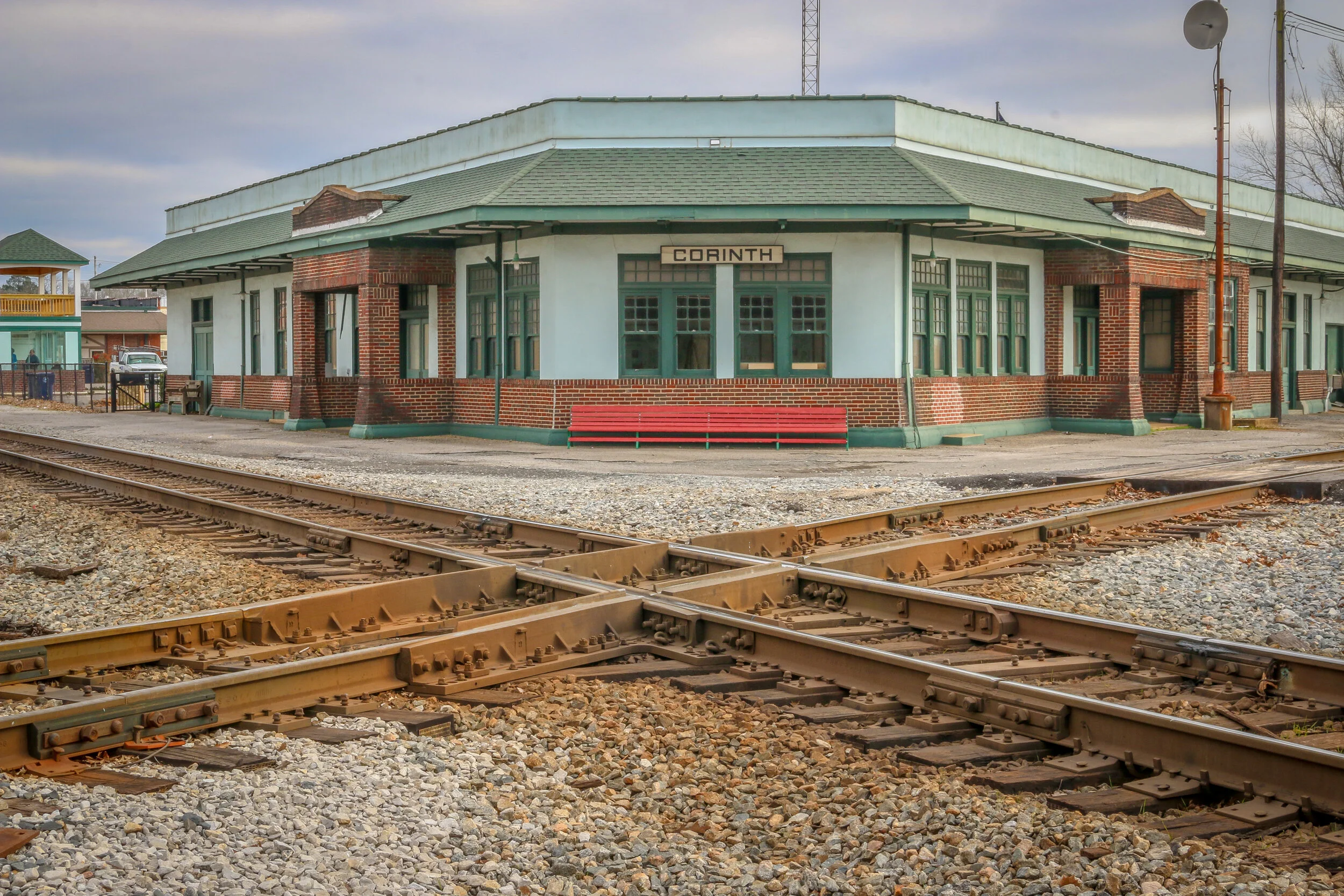
Corinth was my first stop in Mississippi. I came to learn more about the Mississippi side of Shiloh National Military Park history, and to see the infamous rail crossing which was of such strategic importance during the Civil War that both sides suffered enormous casualties trying to secure it. I also wanted to learn more about the “Contraband Camp” which grew from enslaved people fleeing behind Union lines. You can see my photos from the Tennessee side of the battle HERE and from the Contraband Camp HERE. I thought both were really interesting, but while I was in town I thought I would have a wander and take a few photos. The weather was overcast until right before I left, and it was really cold out and dark by 5, so I didn’t get to see as much of it as I would have liked. I know there is a lot more to Corinth than these photos, but I still thought I would share them with you here. It was a beautiful town with a fascinating history and definitely worth a visit. Corinth was originally called Cross City when it was founded in 1853 at the crossing of the Mobile & Ohio and Memphis & Charleston railroads and is today home to about 15,000 people.
Gadsden rests quietly on the banks of the Coosa River in Northwest Alabama. Founded in 1825 and originally called Double Springs, the town was renamed in honor of American diplomat James Gadsden. James Gadsden was most famous for negotiating the Gadsden Purchase, which included parts of southern Arizona and New Mexico, the acquisition of which allowed for the building of a transcontinental railroad. The town of Gadsden was once a major riverboat port and would become a center of industry during the industrial revolution. That industry would allow Gadsden to thrive for much of the next century, but as companies left town in the seventies and eighties, the city fell on hard times. Gadsden has worked hard to redevelop its downtown area and while it’s definitely a sleepy town, it has a lot of charm. I really enjoyed my visit to Gadsden. I hadn’t been there in many years and was happy to see so many storefronts occupied and to find downtown bustling. If you ever find yourself in the area, set aside some time for a stroll downtown, a visit to the art gallery and some seafood at one of the many excellent restaurants in town. You’ll be glad you did. Enjoy these photos from downtown Gadsden, Alabama’s City of Champions.
Hello everyone! It’s starting to get warm here in Alabama which means it’s about time for me to start heading north. And I guess I have! It’s been a great week here in Northern Alabama which started with music and history in The Shoals and is ending in the beauty of nature in Little River Canyon. I’ve jammed out in FAME Studios, been moved by the actions of the Freedom Riders and swam in a clear mountain river. This has been my last full week here in Alabama, and it’s about time to turn my headlights towards home for a while. I must say that Alabama has been one pleasant surprise after another. It’s clean, friendly and I’ve had a great time here. Whatever preconceived ideas I had or stereotypes I bought into have, as they have everywhere else, been shattered by the time I’ve spent here. And that’s really been the point of this whole trip - to see things with my own eyes and interpret them with my own mind and heart and come away with my own understanding. And it’s been amazing.
After I posted last week’s This Week, I worked until the library closed at 7, trying to get some photos edited and published and a few other things done. Afterwards, I went to downtown Florence and had a nice walk around the city and took some photos. Then, in the mood for some live music, I went and saw Katlyn Barnes sing at The Boiler Room in the basement of The Stricklin Hotel. The show was good and Katlyn really has a soulful voice and personality. When she was done, I headed out to Swampers Bar and Grille at the Florence Marriott to see Hank Erwin play. They’ve done a really great job with this bar which is full of old guitars, photos and memorabilia from the glory days of Muscle Shoals. Hank was great and this was a good place to round out my evening…
Demopolis is a beautiful town in the heart of the Canebreak region of Western Alabama. This part of the state was once covered with thick stands of a native bamboo-like species called Arundinaria. While much of this cane was destroyed to make room for cotton plantations, the area is still called the Canebreak, and Demopolis is the region’s biggest town. Demopolis was founded by a group of French expats in 1817 and given its name from the Greek for The People’s City. It would become a major transportation hub, sitting at the confluence of the Black Warrior and Tombigbee Rivers, a status which would only grow when the railroad arrived. Today, Demopolis is a quaint and quiet town of around 7,000. I really loved it there and kept thinking it’s what a Norman Rockwell painting would look like if it aged a few decades. The old brick buildings have stood up well to the tests of time and the town has a lot of charm to it. While I wish I had had a little better weather to take these photos in, I still think they show the beauty of Demopolis, a small town which is the heart of the Canebreak.
As I was driving through Double Springs, Alabama I saw in front of the courthouse what looked like the ubiquitous small-town war memorial which I have found pretty much everywhere I’ve visited on this journey in both the North and the South. But this one was different because unfurled behind it were both Union and Confederate flags, so I hit the brakes and went in for a closer look. What I discovered was a Civil War memorial to The Free State of Winston. The plaque on the memorial read as follows:
DUAL DESTINY
The Civil War was not fought between the North and South but rather between the Union and Confederate armies. Perhaps as many as 300,000 Southerners served in the Union Army. The majority of the Appalachian South, from West Virginia to Winston County, was pro-Union. Winston provided 239 Union and 112 Confederate soldiers, 21 of whom shared last names.
Selma, Alabama is a stunning city. Rarely have I driven into a place on this whole journey where I have been more eager to jump out of my van and start taking photos. The downtown area is packed with historic buildings reminiscent of days gone by. The neighborhoods are full of old Victorian-era mansions that hark back to better days in the Queen City of the Black Belt. As in most of the Black Belt of Alabama, cotton was king during the antebellum period and Selma’s position right on the Alabama River made it a prime place for a thriving city. During the war, Selma was a major shipbuilding center and manufacturing town for the confederacy. The post-war years were difficult on Selma and race relations were strained way past the point of breaking as lynchings and intimidation were common occurrences. Selma became notorious during the Civil Rights Movement, especially on the topic of voting rights, and was the jumping off point for the Selma to Montgomery March. Driving or walking around Selma today, it is apparent that the city has seen better days. Buildings are crumbling and many of the old homes are boarded up and falling apart, but it doesn’t take a lot of imagination to picture what it once was. As in so many parts of the country, the economy in Selma is struggling and there aren’t enough jobs or money to go around. I hope for the best for the future of this beautiful city. You should definitely go for a visit, spend some time in the wonderful Selma to Montgomery National Historic Trail visitor center run by the National Park Service, walk across the Edmund Petus Bridge and then just go for a ramble and see what you can find. While at first glance you may think that “Queen City” is a bit grandiose, but the deeper you look the more appropriate you’ll find it. I hope you enjoy these photos from The Queen City of the Black Belt.
Rickwood Field in Birmingham, Alabama was built by industrialist Rick Woodward, and opened its doors for Opening Day on August 18th, 1910, making it the oldest professional baseball park still standing in the United States. In its heyday, RIckwood saw the likes of Ty Cobb, Shoeless Joe Jackson, Babe Ruth and Hank Aaron pass through its gates. In addition to being home of the Birmingham Barons, Rickwood Field was also home to the Negro League’s Black Barons. Local legend Willie Mays got his start with the Black Barons at Rickwood when he was just 16. The great pitcher Satchel Paige also spent several years with the Black Barons in the 1920’s. During the sixties, there was a minor league affiliate of the Kansas City (later Oakland) A’s playing at Rickwood, which included on their roster Reggie Jackson and Rollie Fingers. When the A’s left town, a new Barons team was brought in several years later, and played at the old stadium until 1987. Today, the Barons play one game a year at their historic stadium, called the Rickwood Classic. The field is still used regularly though, hosting local high school games, adult recreation leagues and even the odd corporate softball game or wedding. Since 1992, the stadium has been in the care of the Friends of Rickwood who not only maintain the stadium, but have attempted to restore it a little at a time to it’s 1948 appearance. The stadium has been used in several films including Cobb, Soul of the Game, and, most recently, 42. It is a wonderful place to visit and is full of history and nostalgia. I spent time just sitting in the bleachers and enjoying the quiet view. Next time you’re in Birmingham, go check out Rickwood Field. If you like baseball or just cool old buildings, I’m sure you’ll enjoy it as much as I did.
Montgomery, Alabama is a town full of history. Founded on the Alabama River soon after Alabama became a state in 1819, it became the state capital in 1846. Montgomery served as the capital of the Confederacy for four months following the state’s secession, and is where Jefferson Davis took his oath of office as President. Montgomery has also been the site of many Civil Rights battles, from the Montgomery Bus Boycott to the Selma to Montgomery March for voting rights. Martin Luther King Jr. served as the pastor for the Dexter Avenue Baptist Church for several years. Today, Montgomery is a clean and quiet city with some beautiful buildings, a great riverfront and lots of fascinating museums. I really enjoyed my visit to Alabama’s capital city and hope you enjoy these photos from my stay.