
Viewing entries tagged
Millard County

This Week on the Road - March 12th-18th

Comment

This Week on the Road - March 12th-18th

In Green River, UT

Hello Everyone. A belated Happy St. Patrick’s Day to you all from here in Fillmore, Utah. I’ve spent this last week cutting across the central part of the state, checking out petroglyphs and dinosaur fossils in the east, cruising down the beautiful agricultural region of the Sanpete Valley and finishing up here in Utah’s first territorial capital. It’s been windy out here this week, but the temperatures have been pleasant and the rain and snow have stayed away, which was a good thing as some of these high mountain passes have taken me up above 9000’. Central Utah is definitely a less-visited part of the state, but it has a lot of cute towns, friendly people and plenty to keep me busy. I’ve been moving fast this week because there’s a powwow I want to get to in Salt Lake City this coming weekend and these are all places I wanted to hit before heading in that direction.

Green River’s Old Ambulance

When I left you last week, I was out in Grand Junction, Colorado after a quick visit to Colorado National Monument. After I wrapped up my newsletter, I made a beeline back to the Beehive State and headed straight to Green River. I wanted to get there with enough time to see the John Wesley Powell River History Museum. If you don’t know of him, Powell led the first expedition to float the length of Grand Canyon. A retired U.S. Army Major, he had lost his right arm due to a gunshot through the wrist he received during the Battle of Shiloh, one of the bloodiest and most fascinating battles of the Civil War. After the war, he went on to become the curator of a small natural history museum in Illinois and went west to gather some samples for the museum. While there, he became fixated on the idea of exploring Grand Canyon and collected a rag-tag crew of mountain men and explorers to come with him. It was quite the adventure and this museum does a good job of documenting their trip and providing some great information on Powell himself. There are also displays on the geologic and human history of the Green River (which joins the Colorado River in what is now Canyonlands National Park and which Powell floated to get to the Colorado on his journey). In addition to the permanent gallery, the temporary exhibit in the museum was also really good. It told the story of photographer Tad Nichols who had gone out to document what he could of Glen Canyon in the years before Lake Powell filled behind the Glen Canyon dam, flooding the area. Now that the lake is experiencing record low water, photographer Dawn Kish set out using Tad’s camera to explore Glen Canon herself and to recreate some of Tad’s historic photos. The exhibit and the film they made along the way were both incredibly well done. The museum sits right on the banks of the Green River at what was historically one of the easier crossings along that stretch of the river in the days before the bridges.

The Great Hunt in Nine Mile Canyon

The museum was excellent, but the rest of the town of Green River has definitely seen better days. There were a number of shuttered businesses and old boarded-up hotels. That being said, I found the town friendly and pleasant and would definitely consider staying there to explore the region. I took a nice long walk up and down the main street and then settled into Ray’s Tavern for a quick beer. Ray’s is one of the few real bars in southern Utah, and it was a busy place on a Wednesday night.

Dinosaurs in Vernal

I was up early on Friday and off and running up the road. Just outside of Green River I turned north on Route 6 and then just shy of Wellington I turned off to head up Nine Mile Canyon. At over forty miles long, nobody is really sure how the canyon got its name, but the most accepted theory is that it was named after the nine-mile triangulation survey done by F.M. Bishop, the cartographer on John Wesley Powell’s second expedition in the area. Powell was pretty good at naming things though, so I don’t necessarily buy this theory, but I also don’t have a better one to offer. Regardless, Nine Mile Canyon is often referred to as “The World’s Longest Art Gallery” as it is absolutely chock-full of petroglyphs and pictographs – mostly from the Fremont People but also with more modern examples from the Ute People who still live in the area today. The canyon follows the path of least resistance through the Uinta Mountains between what are now the towns of Vernal and Price, with the lowest mountain passes and easiest access. It was originally an animal trail and then was used by American Indians for centuries before pioneers made their way through into the area. In addition to all of the petroglyphs and pictographs, there are also some old ghost towns and plenty of dilapidated cabins and barns from the pioneer settlers. I spent most of the day out there in the canyon, taking photos and wandering around. The scenic byway ends at a huge petroglyph panel called The Great Hunt which is one of the more well-known and replicated petroglyph panels in the state. It was definitely worth seeing, but I think my favorite was called Coyote Placing the Stars which is a story which is remarkably common among different Indian bands around the west. Sadly, it was too high up on the cliff for me to get a photo of so I could only admire it through my binoculars.

Welcome to Dinosaur Country

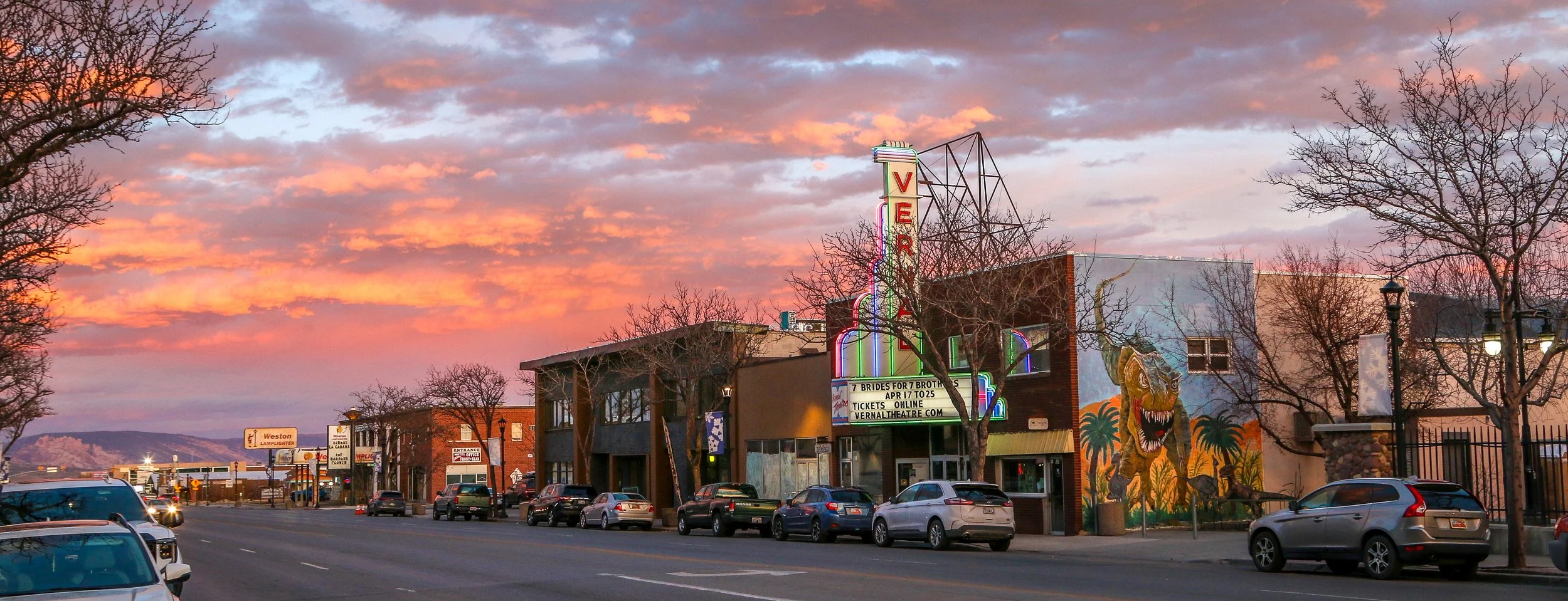
I really enjoyed exploring Nine Mile Canyon and turning north the road rises quickly out of the canyon and then heads out across the highlands until it meets Route 40. Turning east along the highway, I continued on to Vernal. I had been to Vernal once before, but many, many years ago. Driving into town it’s not hard to tell what Vernal’s claim to fame is, as there are dinosaur statues on every corner. This is definitely dinosaur country and has produced thousands and thousands of fossils which are displayed in museums around the world. There are even two dinosaurs from near Vernal in the Smithsonian’s Natural History Museum which I remember fondly from many visits to see them when I was a kid. It was getting late when I arrived in Vernal, but the light was good and the clouds were amazing, so I grabbed my camera and set off into the evening to take some photos before the sun went down.

Dinosaur N.M. Geology

On Friday morning I started my day with a trip out to Dinosaur National Monument which is about 20 minutes outside of Vernal. Back in 1909 a paleontologist named Earl Douglas was sent to the area by the Carnegie Natural History Museum in Pittsburgh to track down some dinosaur bones. After a few weeks, Douglas and his team unearthed their first fossils in a region which would eventually yield 350 tons of dinosaur bones. The quarry on display in the National Monument today was once a river bottom where dead dinosaurs floated downriver until they hit a snag and there the bodies must have piled up. These dinosaurs were covered up with sediment which would eventually turn to rock. At some point, uplift would tilt this rock and Douglas would find this dinosaur pile-up centuries later. The bones have been exposed and stabilized but are very much in their original locations and conditions and it is very cool to see. I spent a good bit of time in the quarry, and then set off down the scenic drive to see some petroglyphs (including a cool panel of lizard carvings) and the amazing geology of the region. The rocks in the area are from vastly different time periods in the earth’s history and it’s a beautiful and strange landscape to drive across. One of my favorite things at the Monument though was very specific to me - a large plastic stegosaurus outside of the main visitor center. This was one of the original dinosaurs put on display by Sinclair Oil at the 1964 World’s Fair in New York. One of the other dinosaurs in that exhibit was a triceratops which stood for many years on the National Mall in Washington D.C. and is now at the National Zoo. This was definitely the most memorable and cherished dinosaur of my childhood, so it was wonderful to see his World’s Fair brother there in eastern Utah. After finishing my time in Dinosaur, I headed back to Vernal and hit the gym for a while (their recreation center in Vernal is a truly top-notch facility) and then went out to take a few photos of the Mormon Temple. While I was out there I met a guy called Bear (his actual last name) who said he was having a bad day and wondered if I would take a few photos of him. I’m naturally pretty wary of anyone who approaches me in a parking lot, but he seemed nice enough so I took a few shots of him and chatted with him for a bit. I hope I made his day a little better.

World’s Fair Dinosaur

I spent Saturday morning at the Utah Field House State Park Museum which is also full of rocks and dinosaurs and is very informative and well laid out. I think the highlight of my trip there was hearing little kids express their amazement at the dinosaur skeletons and models. From there I went up the street to Swain’s restaurant because they had half-price burgers on Saturday afternoon which were really good and a great deal. Then I headed across the street to the Uintah County Historical Museum which had some really neat displays and artifacts. This museum had everything from Indian baskets and pottery to information on Butch Cassidy and other local outlaws to a fascinating collection of hand-made dolls of America’s first ladies. I also thought it was cool that they had a whole wall of printouts answering some (apparently) commonly asked questions like “how did Utah get its name?” (actually nobody really knows for sure, but it seems to have something to do with the Ute Indians and/or with the mountains) and “how to swear in Utah” (“bull-stuff” and “forget that”) and many others. I took all of them and sat and read through them one by one and learned quite a lot in the process. I thought these handouts were a great idea.

Vernal’s Mormon Temple

I had intended on leaving Vernal on Saturday afternoon, but had seen a flyer the day before for an event called Marvelous Xtreme Bull Madness and knew I was absolutely staying one more night. This event was at the fairgrounds in town and was definitely a lot of fun. Vernal is in the middle of a huge agricultural region and people came from all around to watch some bull riding. There were over 40 bull riders there and some of them were really good. While I wasn’t thrilled with some of the political commentary that laced the program, I did really enjoy the night. All of the bulls danced out of the arena after their 8 seconds in the spotlight, but one of the cowboys left on a backboard. It’s definitely the bulls which have the advantage in this sport and it is one of the most dangerous sports on the planet. That being said, the winner of the event took home over $10,000 for his 8 second ride (that’s $1,250 per second). After the last ride, a little bar in town called Little B’s was having some live music so I headed on down to enjoy a little nightlife for a change. While Vernal is most definitely in Utah, it is also only 45 minutes from both Wyoming and Colorado and you can definitely feel the influences of those neighboring states on the town as there are several bars in Vernal. I thought it would be a fun and rowdy night, but even though the band was good the patrons sat stoically watching from their seats and tables. A few old timers got up and danced from time to time, but that was about it. I enjoyed my two beers and then headed out to my van for the night.

Downtown Helper

After three wonderful nights in Vernal, it was definitely time for me to head on down the road. On the way out of town, I made a short stop on the Ute Reservation at Fort Duchesne. There wasn’t a museum or cultural center in town, but they had an awesome war memorial which was definitely worth stopping for. From there, I took off across the 40 and then down the 191 which took me up and over a 9,000’ pass before dropping me down into the heart of Carbon County. I pulled into the small town of Helper, Utah in early afternoon. My good friend Tim recommended I stop through Helper, but after looking at the town’s tourism brochure, I couldn’t really figure out why. As soon as I pulled into town, I got it. Helper (named because they needed to add extra locomotives or “helpers” to get trains up and over the next mountain pass) is very much a time-capsule of a town. It has done an amazing job of preserving its vintage signage and many of the old buildings in town. There are several old gas stations which look like they were transported directly from 1950. I loved it and knew it would be a great town for photography, something which has been lacking during my time in Utah.

Helper’s Main Street

Helper is also the only town in Utah which has an active chapter of E Clampus Vitus, the historic organization I’ve been a part of for many years. In the 1980s, they purchased an old hotel building (which had also been home to the town’s last operating brothel which was open until the mid-1970s) and converted it into their clubhouse. I rolled in there in the afternoon and met James, a retired coal miner who was the afternoon bartender. He welcomed me in and told me all about their local Easter egg hunt and the Christmas charity they run with the local United Way to be sure that needy local children get a good Christmas. Several more Clampers came in while we were chatting and I ended up spending a few hours there hearing about the town’s history and all of their wonderful events. In late afternoon, I went out to take some photos around town and then went back in for another beer before calling it a night.

An Old Conoco Station in Helper

Helper looks even better in the morning light and I enjoyed a long walk around on Monday morning, taking photos and reading all of the historic plaques which the Clampers have placed around town. From there I drove out to Kennilworth, another old coal town which has some cool company housing and the old company store but not much else to see. Then I headed down to Price to get some groceries and get some work done at the library. When I finished up, I took a long stroll around town and enjoyed seeing their two old theatres and a sizeable Greek Orthodox cathedral. I had an ice cream and then decided to go back to Helper for the night as it was quiet and an easy place to park.

The Old Roller Mill in Fairview

I was up and out early on Tuesday though, as I wanted to get out into the Sanpete Valley and spend the day cruising south. Going up and over another snow-covered high mountain pass, I dropped down into the town of Fairview. There I found a wonderful little museum which had relics of early pioneer history in the area and also a replica skeleton of the Huntington Mammoth which was discovered in the nearby area. It had been amazingly preserved where they found it and they were able to sequence its DNA and found out it had both Columbian and Wooly Mammoth genes which was the first definitive proof that these creatures had been able to interbreed. Also in the museum were casts from local sculptor Avard Fairbanks who was quite prolific during his lifetime. Not only had he created many famous Mormon sculptures including several in Temple Square in Salt Lake City, but he had done three of the statues found in the U.S. Capitol’s Statuary Hall. He also did several famous Lincoln statues and the statue of George Washington in the Washington State Capitol among many others. It was really interesting to see so much of his work on display in this little town in central Utah.

A Pioneer Home in Spring City

From there, I continued on to Mount Pleasant which also had some really cool pioneer history and buildings. I spent some time chatting with four young men on their LDS mission in the area, which I found interesting since it is a predominantly Mormon region. They were all really interesting and I enjoyed our conversation but they didn’t convince me to convert. I popped into the Triangle Bar in the middle of town for a quick beer, seeing as it was the only bar in the whole valley and it was St. Patrick’s Day. The darkest beer they had was a Sierra Nevada, but it came out of a tap with a green handle so I took it. I enjoyed chatting with the bartender, but still had ground to cover so I made it a quick one and headed down the road. I did stop at the liquor store before I left town and bought all four bottles of Guinness they had on the shelf. I popped them in the fridge for later.

Casino Star Theatre in Gunnison

From there I went out to Spring City which has settled in 1852 and had a ton of historic pioneer buildings and a lot of history. It also had a wonderful natural spring in the middle of town from which it takes its name. I took a nice, long walk around, soaking up the history and checking out the old buildings. It’s a small town but an interesting one. From there, I continued down the valley to Ephraim which has a beautiful temple and is home to Snow College. While I was looking for things to do in the evening, I saw that there was going to be a St. Patrick’s Day concert just 15 minutes up the road in Moroni at their little opera house, so I headed out that way. It was a fun event and the music was good but the highlight of the evening was a 7 month-old girl named Gail who was in front of me and had a green bow in her hair and a rainbow on her shirt and was just the cutest. The band played a few Irish songs and some local girls did some Irish dancing and it was really nice to celebrate the day in Mormon country. When the band played a song called “Whiskey for Breakfast”, it raised a few eyebrows and the crowd got real quiet and I don’t think the singer won them back by proclaiming it was “non-alcoholic whiskey”. Regardless, Mormons are resilient and they bounced back quickly and it was a nice evening all around. I headed back to Ephraim for the night, and enjoyed my Guinness in my van with some Irish tunes on the stereo.

Manti Temple

This morning I continued down the valley, starting with a nice long walk around Manti, the Sanpete Valley’s original Mormon town. Brigham Young sent 50 families there in 1849 at the invitation of Ute Chief Walkara who wanted the Mormons to teach his people how to farm. The goodwill between these groups would last for a while, but would eventually lead to hostilities. That being said, Manti has the biggest and most beautiful temple in the valley, as well as a gorgeous tabernacle and many wonderful homes and businesses. I also liked that their high school mascot it The Templars. Most of the stone buildings in the valley are built from locally sourced oolite limestone and were cut and placed by Danish Mormon pioneers who were quite skilled at stonemasonry. I had a nice visit to Manti and then continued on to Gunnison where I stopped to see the Casino Star Theatre, definitely the prettiest small-town theatre I’ve seen in a long time. From there I headed through Salina and then made my way up and out of the valley Scipio and then headed down to Fillmore.

An Old Store in Scipio

Fillmore was the Utah Territory’s original capital city. In what was once a much larger Utah Territory which included sizeable chunks of what are now bordering states, this was very near to the geographic center and Brigham Young came himself and declared it the territorial capital. Hoping their proposed state of Deseret would be accepted into the union, Young tried to curry favor with the president by naming the capital Fillmore and the county it sits in Millard County. President Fillmore was honored and helped them raise $20,000 to begin construction on a capitol building, but that all fell apart when he lost his reelection bid. Polygamy was going to be the hurdle that kept them from statehood which was interestingly linked to states rights and therefore to slavery. Only one section of the building was ever completed and they held three legislative sessions there before the capital was moved to its current location in Salt Lake City. Now The Old Statehouse State Park, it houses an interesting museum which has a lot of local history and touches on the Utah War (between the U.S. Army and the Mormons, waged by President Buchanan who probably should have been focused on holding the Union together) and other topics. At some point, the building was taken over by a Presbyterian mission who ran a school there and tried to convert the Mormons in their attempt to end polygamy in Utah from a different angle. I wish there was more to this museum as I felt like they just touched on the some of these topics, but it was still an interesting place to visit and it looks like they have more exhibits in the works.

Fillmore’s Old Statehouse

And that’s where I find myself now. I’m actually in a conference room at city hall which they have graciously allowed me to use to finish up this week’s post. From here, I am heading north to Delta to explore the story of the WWII Japanese internment camp of Topaz. I will also hopefully get a look at the ruins of the old Mormon Fort Deseret. Tomorrow I hope to make my way north to Utah Lake and begin to explore the towns of Spanish Fork, Provo and Orem. As I mentioned at the top of this post, I really hope to make it to the powwow at the university on Saturday to try and connect with Utah’s Indian population and see what they have to say. I will spend the rest of the week in the Greater Salt Lake area and will let you know next week how it all went. I hope you’ll come back and join me then. Have a great week out there, wherever you are and thank you, as always, for reading.

-Mike

Balanced Rock in Nine Mile Canyon

Robber’s Roost Inn in Green River

A Lady of the Evening in Helper

Helper’s Strand Theatre

Big John Coal Mining Statue in Helper

More Helper Nostalgia

I Liked This Sign and the Sky Behind it in Vernal

Ute War Memorial in Fort Duchesne

Big Buffalo Panel in Nine Mile Canyon

Bear Paw Petroglyph

The Owl Panel

Hand Petroglyph

Shadow Catcher in Nine Mile Canyon

The Road to Nine Mile Canyon

The Quarry Wall in Dinosaur

Pioneer Cabin in Nine Mile Canyon

On the Ute Reservation

Vernal Dino Mural

The Vernal Theatre

Bear Posing in Vernal

Sherald’s Frosty Freeze in Price

Downtown Mount Pleasant

Ephraim Temple

I Loved This Statue in Manti

Dusk in Vernal

Comment