
Viewing entries tagged
Little Bighorn

This Week on the Road - July 30th - August 5th

Comment

This Week on the Road - July 30th - August 5th

Shadow Catcher at the Historic Occidental Hotel in Buffalo, WY

Hello Everyone!

Greetings from the prairies of eastern Wyoming. I have officially turned my headlights east and I have begun my long journey home. It’s been a fascinating time here in the Rocky Mountain states and I would love to keep exploring for the rest of the year, but between the crazy heat of the last month and the issues I’ve had with my van this summer, I have decided it’s time for me to go home for a while. When I get there I’ll be able to sort some things out, regroup and get ready to get back to it again in 2027. It’s not been an easy decision, but I think it’s a good one and I’m starting to wrap my head around it at this point. Waking up super early so I can drive somewhere and then spend all day either inside or sitting under a tree is not a lot of fun and even though the summer is waning, it looks like another month of heat could be ahead. The work I needed to have done on Shadow Catcher this summer highlighted how old she is getting and how hard it will be to keep getting parts and also just how far away from home I am in a 30 year old vehicle. Even though she’s been running really well for the last few weeks, I think it’s time for her to find a new home with someone who needs and expects less from her than I do going forward. So I have slowly begun my eastward journey with no plans to speed across the country, but with every intention of getting there in the next few weeks. That said, I’ve had a really interesting week here in northern Wyoming and southern Montana exploring small western towns and some of the battlefields of the Plains Indian Wars. The heat broke on Monday and I have done my best to make the most of the last few days with cooler conditions to run in. I’ve certainly slept better, that’s for sure. So without further ado, let’s get into it.

A Caboose at the Museum in Greybull

After leaving you last week, I finished up a few things and then strolled down the road and checked into the historic Greybull Hotel for the night. The Greybull is a charming small-town hotel which was clean, comfortable, very reasonably priced and right in the middle of town. I plunked my stuff down and cooled off for a minute and then wandered down the street to the tiny Greybull Museum. The museum was really small, but had a lot of cool rocks and fossils from the area and some nice historic artifacts from the town as well. From there, I popped next door to CC’s pizza for dinner and then went for a beer at the Smokehouse Saloon. On Wednesdays they were charging 25¢ for a draft beer or $1.50 for a pitcher. I showed tremendous restraint by limiting myself to just one pitcher, but I had paid for a nice hotel room which I wanted to get back to enjoy it, which is exactly what I did. It was quite nice to relax on my couch, in the air conditioning, and watch some TV for a while. I know that is something many, many people do every night, but for me it was a luxury.

The Historic Hotel Greybull

The hotel had a nice continental breakfast spread in the morning, which was also great. I enjoyed having a leisurely meal and a few cups of coffee as I read the morning paper. My leisurely breakfast was interrupted by a loud crash as an accident happened right out in front of the hotel. I couldn’t quite figure out how it happened as it’s a quiet town and the intersection did have a traffic light. I don’t think anyone was hurt, but the volunteer fire department was summoned and this tiny, two-car accident ended up surrounded by an ambulance, a fire truck and several police cars - plus the tow truck when it arrived. It was quite an exciting morning in Greybull, Wyoming.

A Beautiful Cody Mural

After checkout I zipped on down the road to Cody, Wyoming, the eastern gateway town to Yellowstone National Park. This is a town founded by and named after Buffalo Bill Cody and the main attraction in town is the cavernous Buffalo Bill Center of the West. This massive museum complex includes a natural history museum, an art gallery, a museum of the Plains Indians, the largest firearms collection in the world and a whole section devoted to Buffalo Bill himself. If you’re ever in Cody, it’s definitely worth checking out. As for me, I’ve been there several times before and wasn’t going to shell out the $23 entrance fee this time around. Instead I paid a mere $2 to go into the local historic society’s museum instead. This is a tiny little museum located in what was once a private home, and told the short version of the town’s history from the original Crow Indian inhabitants who passed through the area on their seasonal migrations all the way up to somewhat modern times. There was a lot of reading involved, but they also had some cool old artifacts on display as well. At the end of my visit, I had a nice long chat with one of the docents who had grown up in Cody and loved to talk about the old days. He gave me some good pointers on restaurants and live music as well, which is always appreciated.

Buffalo Bill Would Have Liked the Camel

From there I wandered a block over to the historic Irma Hotel, financed by Buffalo Bill himself and named after his daughter who would sadly die of the Spanish flu just after WWI. The ground floor is full of animal heads and old-west memorabilia and is a neat place to have a look around, but out on the front lawn was something even better – a live camel lying in the shade and watching the world go by. After wandering around town for a while, I returned to the Irma for their cowboy shootout, staged nightly right on the street in front of the hotel. Seeing as they do the shootout every night during the summer, and seeing as it was the end of July, I imagined they would have it pretty dialed in. Instead it was long and drawn out and painfully boring for a shootout. By the time they finally, finally shot the bad guys, I definitely needed a beer. Just down the road from the Irma, there was a nice community gathering going on at City Park with live music and food trucks which was a lot of fun. Afterwards I went back to the Irma for a beer and chatted with some friendly Australian tourists and a lady who had grown up just down the road. I had a nightcap at the Silver Dollar Bar and then called it a night.

The Schoolhouse at Old Trail Town

Friday was going to be a hot one, so I was up early and headed just outside of town to visit Old Trail Town. This is an outdoor museum composed of old-west buildings which have been moved to the site from all over Wyoming. I appreciate museums like this which preserve local history and save these old gems from being knocked down and sold for scrap. Among the buildings there was the cabin of Old Curly, a Crow Indian scout who had guided George Armstrong Custer in the days leading up to his last stand at the Little Bighorn/Greasy Grass, and lived to tell about it. There was also a cabin once inhabited by Butch Cassidy (he sure got around) and a saloon he once frequented with several other members of the Wild Bunch. There was an old schoolhouse, a brothel and plenty of old wagons, saddles and Indian artifacts. On the far end of the museum was a cemetery full of old-west figures which the museum had dug up and reinterred on their land, a practice I’m not particularly fond of. One of the graves was for John “Liver Eating” Johnson. After serving in the Mexican-American War, Johnson came north where he spent some time at the gold diggings near Virginia City, Montana. One day while he was away, his wife, a Flathead Indian, was killed by a young Crow warrior and Johnson would spend the next few years of his life seeking revenge for her murder. The story goes that whenever he killed a Crow, Johnson would cut out their liver and eat it, hence his nickname. Later in life he made peace with the Crow, and at some point moved to Santa Monica, California where he died and was buried. When he was re-interred at Old Trail Town, Robert Redford, who had played Johnson in a movie, served as one of his pallbearers. Old Trail Town was an interesting place to spend the morning.

Team Roping at the Cody Night Rodeo

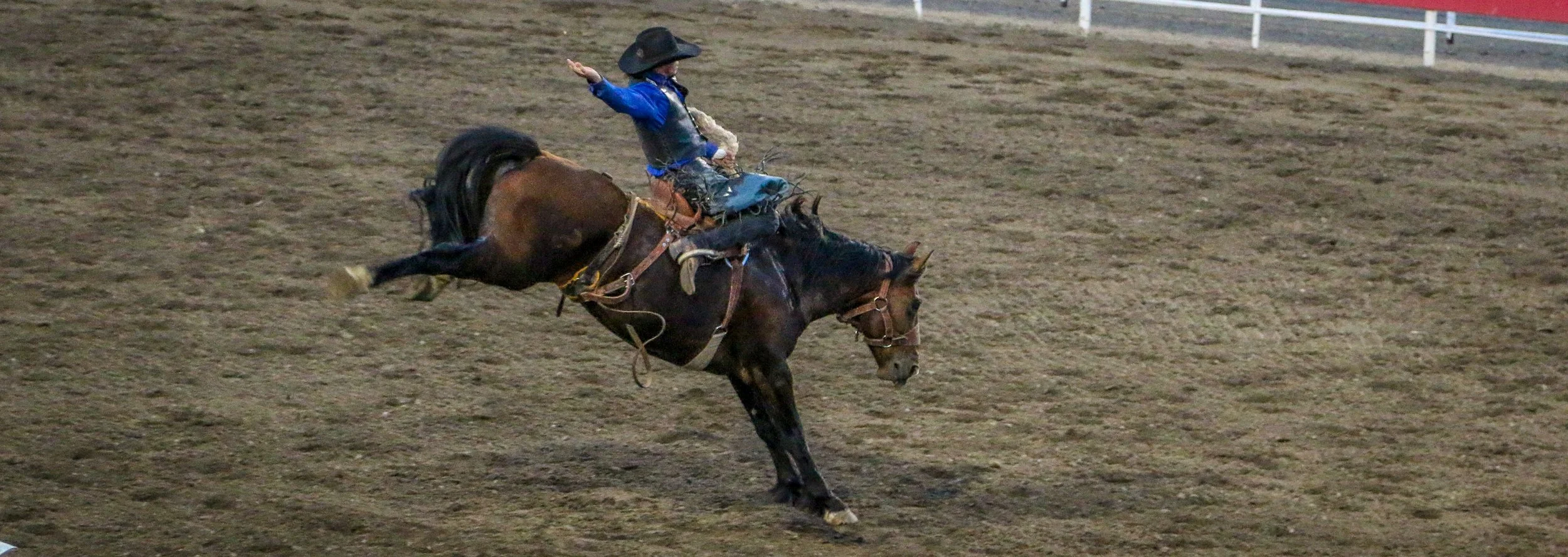
I spent the afternoon chilling (quite literally) in the library. Cody has a big, beautiful, quiet, cool library and I had plenty of photos I wanted to have a look at. It was nice to have some time in the afternoon to just hang out inside for a while and get some work done. After a decent workout at the town’s recreation center, I headed just outside of town to the Cody Night Rodeo. The town of Cody puts on a rodeo every single night throughout the summer and it’s always a good time. Because of its nightly status, this is definitely not the best rodeo you’re ever going to see as it’s mostly young and novice cowboys and cowgirls who are participating. Several of the contestants were in their mid-teens and one bull-rider was 44 and decided he wanted another go at being a rodeo star (he lasted less than 2 seconds). That being said, because they do it every night they have the spectacle of it down to a science and they do an excellent job of keeping everyone excited and entertained. I had a couple of cold beers, a delicious plate of nachos and a grand old time watching the show. It was a fabulous Friday night at the rodeo.

One of the Original Barracks at Heart Mountain

On Saturday morning I headed just up the road from Cody to visit the Heart Mountain Relocation Center, another of the World War II Japanese internment camps. If you’ve been following this blog for a while, you’ll know that I’ve visited the camps at Manzanar in California, Gila in Arizona and more recently Minidoka in Idaho and Topaz in Utah. The internment of American citizens of Japanese ancestry without trials or due process was a truly disgraceful chapter in American history and the camp at Heart Mountain held over 14,000 people during the war. They lived in tarpaper and plywood shacks, used common latrines and were forced to work for wages which were 10% of what normal wages would have been at the time. Temperatures were blazingly hot during the summer and well below zero during the winter and there was never enough food, clothing or blankets to go around. And yet they persevered and hoped for better days to come. About 800 of those who were brought to Heart Mountain left the camp and went directly to boot camp. From there they went off to war while their parents, wives and children remained confined behind barbed wire on the sagebrush plains of northwest Wyoming. When the camp closed in 1945, each person was given $25 and a train ticket to wherever they wanted to go. With very few exceptions, they had to start over from scratch as their homes and businesses had often been destroyed or taken over by someone else. There isn’t much left at Heart Mountain these days except for a few of the old barracks, a root cellar and the chimney from the old hospital’s boiler room. The museum there is excellent, though, and is a Smithsonian affiliate so they have some awesome photos and memorabilia from the camp. It’s not a happy place to visit, but an important one and I’m glad I spent the day there.

The Most Boring Shootout in History

Temperatures were hitting 98° by the time I left the museum, and as I mentioned last week I still needed to get a full charge on my battery, so I got a spot at the Ponderosa Campground right in the middle of town for the night. I headed over to the library for a while to get a little bit more work done and then I drove back to camp to let my van charge, got some laundry done and had a shower. I walked back into town and wandered over to the old Chamberlain Hotel which had live music out back on the lawn. The young lady singing had a beautiful voice and it was nice to sit outside in the shade and listen. From there I popped over to the Irma for a couple of beers and then to the Silver Dollar to watch a set by the Cul de Sac Cowboys, a fun, high energy band out of Kansas City.

Devil’s View at Bighorn Canyon

I packed up and took off early on Sunday because it was going to be the hottest day of the week. I cruised about an hour up the road to Lovell, where I planned to ride out the day. When I got there I immediately headed out to Bighorn Canyon National Recreation Area. I stopped into the visitor center for a few minutes and then took off to get some views of the canyon itself. Devil’s View was awesome and offered tremendous views down to the Bighorn River and out at the geology of the canyon. I also dropped down to river level at Horseshoe Bend but it was already starting to get too hot to think out there, so I only stayed for a few minutes and then made my way back into town. Lovell has a beautiful free campground with plenty of shade and even a nice bathroom block with showers. I was the first one there for the night, seeing as it was only noon, so I picked a good, shady spot and settled in for a hot afternoon. I did some reading, watched a little TV on my phone and called some friends to catch up. I even heard from my dear friend Barbara in England who turned 84 this year. It was intensely hot out there, but the shade helped and the day passed by pretty quickly. In the late afternoon I wandered down into town for some dinner. There isn’t much to Lovell, so it wasn’t hard to choose a restaurant and the one I went with was Mustang’s Café and BBQ. I wasn’t sure they were open when I got there because there wasn’t anyone there, but it turned out to be a good choice. I wanted to try their barbecue, but it was so quiet there I was afraid it would be old and reheated so I went with a burger instead. It was actually one of the best burgers I’ve had in a very long time, and the onion rings were hand cut and house battered as well. I left there quite satisfied and wandered across the street to the Shoshone Bar, which was even easier to choose as it’s the only bar in town. The bartender that night was Maxine who was from just down the road in Basin, Wyoming. It was busy when I got there (small-town busy at least), and she was hustling, but when it slowed down we got to chew the fat a little bit. She was wearing a lovely, long dress which she referred to as a “prom dress”. Dresses of that style were her preference and she said she wears them every day and that people around town make fun of her for it, but it makes her happy so she doesn’t care. I liked Maxine and her unique style and it was fun to hang out with her for an hour or two until the sun had gone down and the day had started to cool off. When I climbed into my van at 11pm, it was still 80° out, but the wind was picking up. It was still pretty warm inside my van as well, but I managed to drift off in a reasonable amount of time.

The Alhambra-Inspired Entrance at the Moss Mansion in Billings

The heat was supposed to break on Monday and it certainly did. I was up and off pretty early and it was actually nice and cool out. My drive up to Billings was ridiculously windy, and Shadow Catcher is not the most aerodynamic of vehicles, but by the time we crossed back into Montana the winds had calmed down some. Billings is not known as the most attractive city in Montana, but I still wanted to have a wander and see what it was all about. I strolled around downtown and had some lunch and didn’t really see anything that caught my eye, but the weather was so much cooler than it has been that I didn’t mind. I did want to check out the Moss Mansion while I was there, though, so after lunch I headed in that direction. P.B. and Mattie Moss both came from Missouri and settled in Billings in 1892, not long after the city’s founding. P.B. bought an interest in a local bank, but his business holdings would diversify to include everything from sheep and cattle to the local telephone company. The mansion they built was quite the showpiece, especially for Billings at that time (and now for that matter). It stayed in the Moss family for two generations and then was left to the city and is currently managed by the Billings Preservation Society. Because of that direct line of transfer, almost everything in the house is original to the family and to the house. I took a guided tour of the house with Sherri as our guide and we wandered in and out and around the house for almost two hours, while she regaled us with stories of the Moss family and everything that had happened in the house. She was a wealth of knowledge and really brought the house to life. I especially loved the entryway to the house which was designed to resemble the Alhambra in Spain which I had toured just a few years ago. The formal parlor was French Baroque and the dining room was in the Tudor style. I enjoyed the eclectic nature of the house which was incidentally designed by New York architect Henry Janeway Hardenbergh who designed the Willard Hotel in my hometown of Washington D.C. (as well as New York’s Waldorf Astoria and Plaza hotels). It was a lovely house and a fantastic tour.

Moss Mansion in Billings

After leaving the Moss Mansion, I headed to the library for a bit and then made my way down to Billings’ Historic Montana Avenue. While most of Billings is modern and somewhat boring, Montana Avenue has some great old buildings near the historic railroad depot where the city got its start. I stopped for a cider at Last Chance Cidery which is located in an old warehouse which they’ve turned into a lovely open space. From there I wandered across the tracks to Minnesota Avenue which was once Billings’ red light district and Chinatown, but is now mostly abandoned. Back on the right side of the tracks I stopped into Hooligans Irish Pub to raise a birthday pint of Guinness for my dear friend Gillian over in Ireland and then had a quick one at the Montana Brewing Company next door before calling it a night. It was so cool out that I was able to cook dinner in my van which was great. I tucked in for a nice cool night and overnight temperatures dipped down to around 46°F which is pretty amazing since it had been over 100° just the day before.

The Marker for the Mass Grave at the Little Bighorn Battlefield

Yesterday I hit the gym in the morning and then made a beeline for the Crow Indian reservation and the Little Bighorn Battlefield. I had been there once before, but many years ago and I have read a lot about the Plains Indian Wars and this particular battle since then and I was eager to get back. I listened to Paul Jackson’s episode on the battle on his amazing podcast History that Doesn’t Suck on the way to brush up and got there nice and early. As a very brief summary, after Red Cloud’s War in the late 1860s, the 1868 Treaty of Fort Laramie created the Great Sioux Reservation which encompassed a huge swath of land east of the Missouri River, including the Black Hills. When gold was discovered in the Black Hills (during a “mapping expedition” led by George Armstrong Custer which brought along some prospectors to help with the “mapping”), people started heading towards the goldfields. This was a direct violation of the treaty of 1868, and the combined forces of the Lakota Sioux, Cheyenne and Arapahoe started attacking wagon trains and encampments. The army sent out three columns to surround the Indians and squeeze them until they surrendered and then force them back onto the reservation. One of those columns, under General Crook, set out from Fort Fetterman to the south. He engaged with a group of Indian warriors on June 17th, 1876 at the Battle of the Rosebud, southeast of the main Indian encampment at the Little Bighorn. The battle was fierce and both sides suffered casualties but it was not a decisive battle for either side. Crook used a lot of ammunition during the Battle of the Rosebud and decided to return south to resupply and rest before continuing his mission.

The Crow Indian War Memorial

Another of the three columns included George Custer and his 7th Cavalry. They were riding in advance of the main column when they came into view of a thousand tipis spread out around the Little Bighorn River. Custer, being arrogant and no doubt feeling invincible, decided that instead of waiting for the remainder of the column he would take his men and attack. He split his troops into three groups and did just that. They were so vastly outnumbered that they didn’t stand much of a chance, and it was a tremendous victory for the combined Indian army. The Indians would pack up and leave before the rest of the U.S. column showed up and discovered the bodies of their fallen comrades. When I was there this time, I took a fascinating tour of the battlefield with a Crow guide who did a great job of describing the details of the battle. I spent some time wandering around the battlefield myself as well and it is a truly haunting place to visit.

Sheridan’s Legendary Mint Bar

Finishing there in the early afternoon, I stopped quickly at the Crow War Memorial and then continued through the Crow reservation and onto the adjoining Cheyenne reservation where I visited the Battle of the Rosebud (mentioned above) State Park. There was nobody out there but me and I enjoyed wandering around the battlefield in silence and contemplating what might have happened if Crook had continued northwest instead of heading south to regroup. Leaving the battlefield, I made a beeline for Sheridan, just over the Wyoming border. Sheridan is a cute little western town with lots of public art on the street and some beautiful old buildings. It’s also home to the Mint Bar which was established in 1907 and is certainly one of Wyoming’s most quintessential and iconic bars. The wooden bar and booths are both beautiful and there are plenty of taxidermied animals and old guns hanging around to keep your eyes busy. I had a nice Mexican dinner and a couple of beers and then called it another early night due to the blissfully cool temperatures.

A Reconstructed Wall and a Tipi at Fort Phil Kearney

I had another stroll around Sheridan this morning to take some photos and stretch my legs and then cruised on down the road to Fort Phil Kearny State Park. This fort was built a decade before the Battle of the Little Bighorn in response to Indian attacks on emigrant parties making their way up the Bozeman Trail to the Montana goldfields. In this earlier episode of the Plains Indian Wars, the army went and built three forts in the Powder River Basin in response to those attacks. The Indians started harassing the fort even while it was being built, especially with repeated attacks on the work parties which had to travel to bring wood from the forest for the fort’s construction. In December of 1866, the great warrior chief Red Cloud sent ten of his men to the fort as a decoy to try and draw the soldiers out into the open. They bought it and Captain William Fetterman led 80 men in hot pursuit. Cresting a ridge a few miles from the fort, they found not 10 warriors, but a thousand. This would be the biggest defeat during this chapter of the Plains Indian Wars and the greatest loss of life in the region for the U.S. Army before the Little Bighorn a decade later. Red Cloud’s War would continue until 1868 when the U.S. decided to sit down with the chief and negotiate. General Sherman himself signed the treaty which created the Great Sioux Reservation and called for the army to leave their three forts in the Powder River Basin and abandon the Bozeman Trail. It is considered the only time during any of the Indian wars that the U.S. had to negotiate from the losing side. That treaty would hold tenuously for a few years until gold was discovered in the Black Hills and the trail to the Battle of the Little Bighorn would begin. After the army left, the Cheyenne burned Fort Phil Kearny to the ground. Today there is a wonderful visitor center there to interpret what took place in those hills and there is an outline of the fort with some signs and plaques, but little else. I thought it was great to see the countryside and wrap my head around a place I’ve read a reasonable amount about over the years. The lady working at the park was born in D.C., so we had a lot to talk about and I enjoyed discussing everything from the fort to our terrible local football team.

A Beautiful Mural in Buffalo, Wyoming

I left the fort just after noon and drove up the hill to see the memorial where the Fetterman Fight had occurred and then I zipped south to the little town of Buffalo, Wyoming. This is an adorable little historic town with some great buildings and some fantastic murals. I had a quick peak inside the historic 1880 Occidental Hotel which has hosted everyone from Teddy Roosevelt and Herbert Hoover to Buffalo Bill, Butch Cassidy and Calamity Jane to Earnest Hemmingway. It’s got a wonderful lobby and some fantastic old photos on the walls and seems like it would be a great place to stay the night. I enjoyed taking some photos around Buffalo and then dipped into the Sagebrush Café for a sandwich and a delightful slice of hot-from-the-oven blackberry pie. After lunch I set off across the prairies to Gillette, where I’m finishing up this post from now.

Buffalo, Wyoming’s Occidental Hotel

Tomorrow I hope to go visit the magnificent Devil’s Tower National Monument which I have not been to in probably 20 years. It’s definitely one of the most recognizable natural landmarks in all of the west and I’m hoping to get some good photos of it in the morning. Then I’m off to South Dakota and the historic town of Deadwood. Deadwood has a ton of history to it and I’m looking forward to learning more of that history while I’m there. From Deadwood I will head south into the Black Hills and hope to visit both Jewell Cave and Wind Cave while I’m there. And then I’m off and running across the great state of South Dakota. I definitely have a couple of places I want to see along the way, but I will probably only be in S.D. for less than a week. I should be knocking on the doorstep of Minnesota by this time next week, and halfway home, but you’ll just have to check back and see how far I get. Have a wonderful week out there and thank you, as always, for reading.

-Mike

Downtown Greybull, WYoming

Saddle Bronc Ride at the Cody Night Rodeo

Just Missed! At the Cody Night Rodeo

Saddle Bronc Ride at the Cody Night Rodeo

Cute Flower Pot

A Reconstructed Guard Tower at Heart Mountain

In the Hallway at the Irma Hotel in Cody

Heart Mountain

The Old Hospital Chimney at Heart Mountain

I Loved This Mural in Cody

A Cool Motorcycle at the Irma Hotel in Cody

Weird Bear Art in Cody

Old Buildings in Old Trail Town Outside of Cody

A Trapper’s Cabin at Old Trail Town

Curley’s Cabin at Old Trail Town

The Old Saloon at Old Trail Town

The Hyart Theatre in Lovell

Just a Cool Old Car on the Streets of Billings

From the Devil’s View at Bighorn Canyon

Shadow Catcher in Bighorn Canyon

The Formal Parlor at the Moss Mansion in Billings

The Dining Room at the Moss Mansion in Billings

Some Tipis and a Motorcycle on the Crow Reservation

Markers for Where Cheyenne Warriors Fell at the Little Bighorn

Markers for Where U.S. Soldiers Fell at the Little Bighorn

The Lobby at the Occidental Hotel in Buffalo, WY

Evening in Sheridan

The Booths at The Mint Bar

Site of the Fetterman Fight near Fort Phil Kearny

Sheridan is a Cool Western Town

Comment